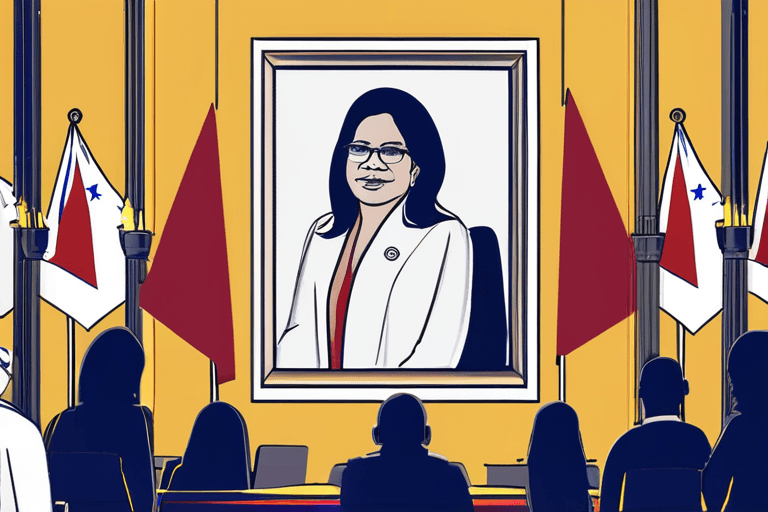
In the bustling halls of Miraflores Palace, a new chapter unfolds in Venezuela's tumultuous political landscape. With President Nicolas Maduro reportedly detained under circumstances that remain shrouded in mystery, Delcy Rodriguez, a figure already well-known on the international stage, has stepped into the role of interim president. Her ascent marks not just a shift in leadership, but a pivotal moment for a nation grappling with economic hardship, political polarization, and intense international scrutiny.
Rodriguez's career has been marked by unwavering loyalty to the Chavista movement, a political ideology rooted in socialist principles and national sovereignty. Before assuming the interim presidency, she served as Executive Vice President, a position that placed her at the heart of the Maduro administration's decision-making processes. Her previous roles include Minister of Foreign Affairs and Minister of Communication and Information, providing her with extensive experience in both domestic and international affairs.
The circumstances surrounding Maduro's reported detention remain unclear, fueling speculation and uncertainty both within Venezuela and abroad. While official sources have remained tight-lipped, rumors of internal power struggles and external pressures have swirled. In this vacuum of information, Rodriguez's leadership is being tested from day one. She faces the immediate challenge of maintaining stability, reassuring the Venezuelan people, and navigating the complex web of international relations.
One of Rodriguez's most pressing tasks is addressing Venezuela's economic crisis. Years of mismanagement, coupled with international sanctions, have led to hyperinflation, shortages of essential goods, and widespread poverty. Her policy approach, thus far, has largely mirrored that of her predecessor, emphasizing state control over key industries and seeking alternative trade partnerships to circumvent sanctions. However, critics argue that these policies have only exacerbated the crisis, calling for market-oriented reforms and greater transparency.
"The key to Venezuela's recovery lies in diversifying its economy and attracting foreign investment," says Dr. Isabella Marquez, an economist at the Central University of Venezuela. "Rodriguez needs to demonstrate a willingness to engage with the international community and implement policies that foster confidence and stability."
The international community's reaction to Rodriguez's interim presidency has been mixed. While some nations have expressed cautious optimism, others remain skeptical, particularly those who view Maduro's government as illegitimate. The United States, in particular, has maintained a hard line, reiterating its commitment to supporting a democratic transition in Venezuela.
"We will continue to hold the Maduro regime accountable for its actions," stated a U.S. State Department spokesperson. "Any interim government must demonstrate a commitment to free and fair elections and respect for human rights."
Domestically, Rodriguez faces the challenge of uniting a deeply divided nation. The opposition, emboldened by Maduro's apparent downfall, is demanding immediate elections and a return to constitutional order. However, the Chavista movement remains a powerful force, with significant support among certain segments of the population. Rodriguez must navigate these competing interests while maintaining the support of the military, a crucial pillar of the Venezuelan state.
As Delcy Rodriguez steps into the role of interim president, she walks a tightrope between domestic pressures and international demands. Her ability to navigate these challenges will determine not only her own political future, but also the fate of a nation yearning for stability and prosperity. The coming months will be a critical test of her leadership, as Venezuela stands at a crossroads, uncertain of what the future holds.















Discussion
Join the conversation
Be the first to comment