Just hours before American commandos seized Venezuelan President Nicolás Maduro, a high-ranking Chinese official met with him at the presidential palace, demonstrating support for one of Beijing's key allies in the Western Hemisphere. The subsequent U.S. operation to capture Maduro sent a clear signal to Beijing regarding the limitations of its influence in a region the U.S. considers its domain. This event, while potentially setting back China's investments in Venezuela, also underscores a broader dynamic that could ultimately bolster President Xi Jinping's vision for China's role in Asia.
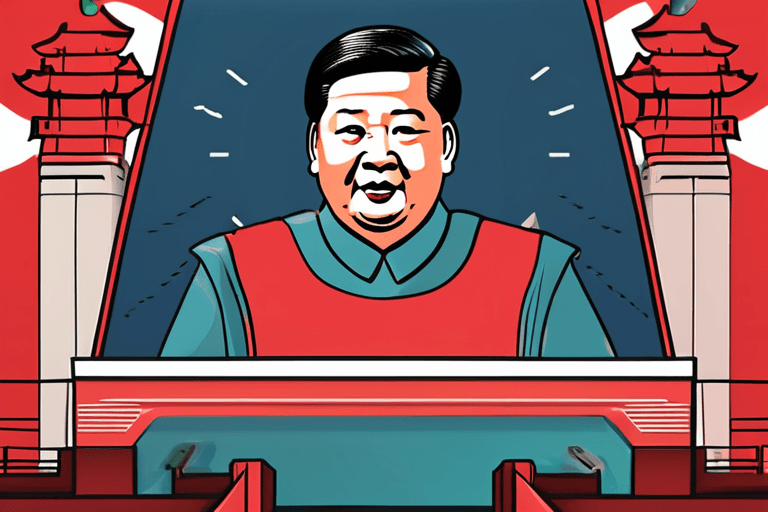
The White House has characterized the Maduro operation as an updated version of the Monroe Doctrine, dubbed by President Trump as the "Donroe Doctrine." This concept envisions a world divided into spheres of influence, with the U.S. dominating the Western Hemisphere and China asserting its dominance across the Asia-Pacific region. This framework suggests a world order where power dictates outcomes, potentially overshadowing established international rules and norms.
The implications of such a "Donroe Doctrine" are significant, particularly in the context of artificial intelligence (AI) and its role in shaping geopolitical strategies. AI, with its capabilities in data analysis, predictive modeling, and autonomous systems, is increasingly becoming a tool for projecting power and influence. For example, AI-driven surveillance technologies could be used to monitor and control populations within a sphere of influence, while AI-powered military systems could enhance a nation's ability to enforce its will.
"The rise of AI is accelerating the shift towards a multipolar world, where regional powers are vying for dominance," said Dr. Anya Sharma, a professor of international relations at Georgetown University. "The 'Donroe Doctrine,' if implemented, would essentially legitimize this competition, potentially leading to increased tensions and conflicts."
The concept of spheres of influence, reinforced by AI capabilities, raises ethical concerns about data privacy, algorithmic bias, and the potential for autonomous weapons systems to escalate conflicts. The use of AI in this context also highlights the need for international cooperation and the establishment of ethical guidelines to prevent the misuse of these technologies.
China's advancements in AI are particularly noteworthy. The country has invested heavily in AI research and development, with a focus on areas such as facial recognition, natural language processing, and autonomous vehicles. These technologies are not only transforming China's domestic economy but also enhancing its ability to project influence abroad.
The latest developments in AI include the emergence of large language models (LLMs) capable of generating human-quality text and code. These models have the potential to revolutionize various industries, but they also raise concerns about the spread of misinformation and the automation of jobs. The ethical implications of LLMs are being actively debated, with researchers and policymakers exploring ways to mitigate their risks.
The "Donroe Doctrine," coupled with the rise of AI, presents a complex and evolving geopolitical landscape. While the U.S. seeks to maintain its dominance in the Western Hemisphere, China is actively pursuing its own vision of power in Asia. The interplay between these two powers, shaped by AI technologies, will have profound implications for the future of international relations.

















Discussion
Join the conversation
Be the first to comment