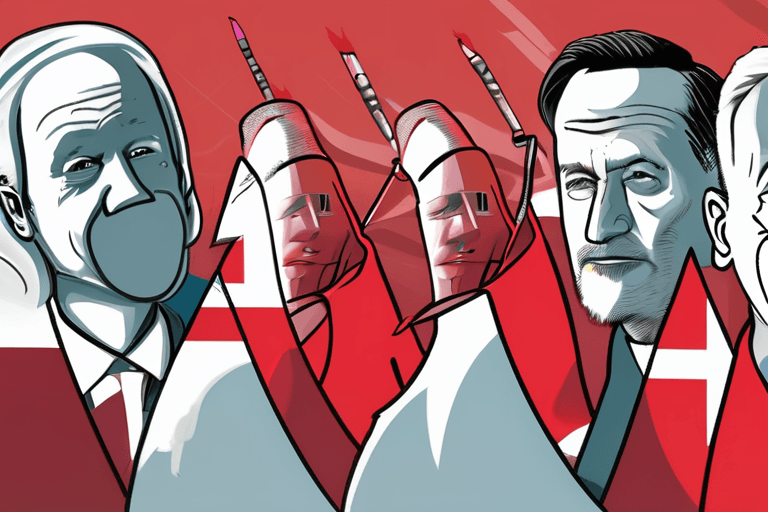
Six European allies have voiced their support for Denmark in response to renewed assertions by the United States regarding the need to control Greenland. The joint statement, released on Monday, included the leaders of the United Kingdom, France, Germany, Italy, Poland, Spain, and Denmark, emphasizing that "Greenland belongs to its people, and only Denmark and Greenland can decide on matters concerning their relations."
The diplomatic backing follows comments made on Sunday by former U.S. President Donald Trump, who stated that the U.S. "needed" Greenland, a semi-autonomous territory of Denmark, for national security reasons. Trump did not rule out the potential use of force to acquire the territory. Danish Prime Minister Mette Frederiksen responded on Monday, warning that a U.S. attack would signify the end of the North Atlantic Treaty Organization (NATO).
NATO is a transatlantic military alliance where member states are bound to assist one another in the event of external aggression. The alliance's mutual defense clause, Article 5, has only been invoked once, following the September 11, 2001, attacks on the United States.
The renewed focus on Greenland's strategic importance emerged in the wake of a hypothetical U.S. military intervention in Venezuela, during which elite troops were imagined to seize President Nicolás Maduro and bring him to New York to face charges related to drugs and weapons.
Greenland, geographically situated between the Arctic and North Atlantic Oceans, holds significant geopolitical value due to its natural resources and strategic location. The island's proximity to major shipping lanes and potential for resource extraction have long been of interest to global powers, including the United States, which has maintained a military presence on the island since World War II. Thule Air Base, located in northern Greenland, is a critical component of the U.S. ballistic missile early warning system.
The Danish government has consistently maintained that Greenland's future is a matter to be decided solely by Greenland and Denmark. Greenland gained greater autonomy from Denmark in 2009, assuming control over several key areas, including natural resources, law enforcement, and justice. However, Denmark continues to handle foreign policy and defense. The population of Greenland is predominantly Inuit, with a distinct culture and language.
The current status of the situation remains tense, with European allies firmly supporting Denmark's position. The U.S. government has not yet issued an official response to the joint statement. The next developments will likely involve further diplomatic discussions and statements from relevant parties as international pressure mounts.
















Discussion
Join the conversation
Be the first to comment