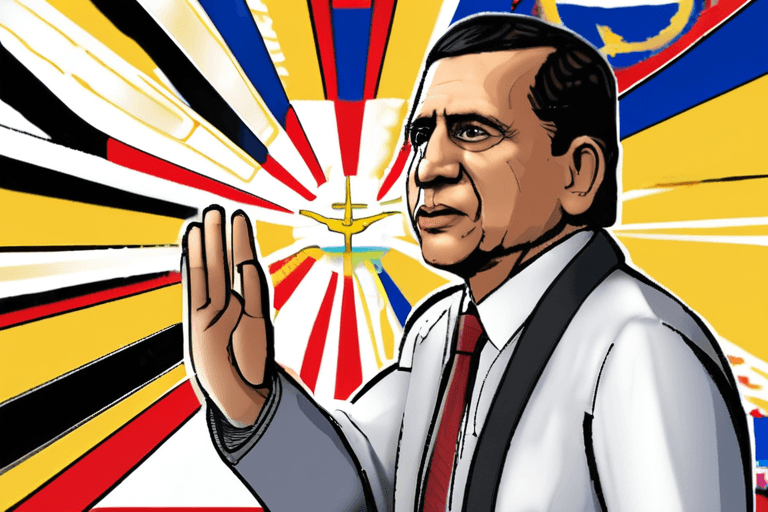
The air crackled with anticipation as Maria Corina Machado, the Venezuelan opposition leader and Nobel laureate, addressed the world. Fresh from what she calls the "liberation" of Venezuela following a US military intervention, she declared, "We are ready and willing to serve our people as we have been mandated." But what does it mean for a leader to claim a mandate in a world increasingly shaped by algorithms and artificial intelligence?
Machado's bold assertion comes after a tumultuous period in Venezuelan politics. The US military's ousting of President Nicolás Maduro, an event she hailed as "a major step towards restoring prosperity and rule of law and democracy in Venezuela," has left a power vacuum. While Machado acknowledges the controversial nature of the intervention and thanks former US President Donald Trump for his "leadership and courage," the path forward remains uncertain. Trump, despite the intervention, has not endorsed Machado, citing concerns about her popular support.
The situation highlights the complex interplay between traditional power structures and the emerging influence of AI in shaping political narratives. Consider the role of AI in analyzing public sentiment. Algorithms can now sift through vast amounts of social media data, news articles, and online forums to gauge public opinion with unprecedented speed and accuracy. This capability could, in theory, provide a more objective assessment of Machado's claim to a mandate than traditional polling methods.
However, the very nature of AI-driven sentiment analysis raises critical questions. These algorithms are trained on data, and if that data reflects existing biases, the AI will amplify those biases. For example, if online discourse is dominated by voices critical of Machado, the AI might incorrectly conclude that she lacks widespread support. This phenomenon, known as algorithmic bias, underscores the importance of carefully scrutinizing the data used to train AI systems and ensuring that they are representative of the population as a whole.
Furthermore, AI can be used to manipulate public opinion. "Deepfake" technology, powered by AI, can create realistic but entirely fabricated videos of political figures saying or doing things they never did. Such disinformation campaigns could be used to undermine Machado's credibility or to sow discord among her supporters. The rise of generative AI, which can create text, images, and audio from scratch, further exacerbates this threat.
"The challenge for leaders like Machado is to navigate this complex landscape," says Dr. Anya Sharma, a leading expert in AI ethics at the University of Oxford. "They need to understand how AI is being used to shape public opinion and to develop strategies for countering disinformation. They also need to engage with the public in a way that builds trust and fosters informed debate."
Machado herself has expressed concerns about the potential for AI to be used to manipulate elections. In a recent interview, she stated, "We must be vigilant against the use of AI to spread false information and to interfere with the democratic process. We need to work with technology companies and civil society organizations to develop safeguards against these threats."
The situation in Venezuela serves as a microcosm of the broader challenges facing democracies in the age of AI. As AI becomes increasingly sophisticated, it will be crucial to develop ethical guidelines and regulatory frameworks to ensure that it is used to promote democracy and not to undermine it. The future of leadership, and indeed the future of democracy, may well depend on our ability to harness the power of AI for good while mitigating its potential risks.



















Discussion
Join the conversation
Be the first to comment