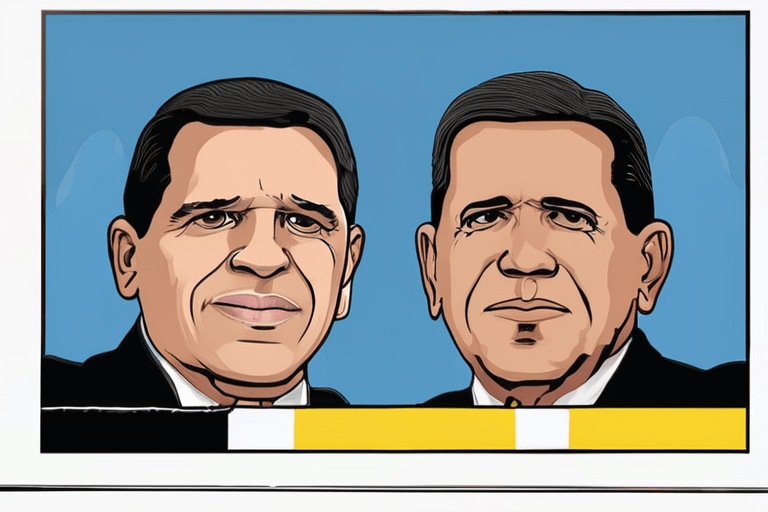
A digital echo reverberated through the virtual halls of Al Jazeera, carrying the weight of accusations and political turmoil. Juan Guaido, once the face of Venezuela's opposition, leveled sharp criticisms against Delcy Rodriguez, the nation's acting president. But this wasn't just a typical political spat; it was a stark reminder of the complex interplay between human leadership, artificial intelligence, and the future of governance.
Guaido's denouncement, delivered in a recent interview, painted Rodriguez as a "dictator and cartel leader." The accusations, while politically charged, highlight a deeper issue: the increasing role of AI in shaping political narratives and influencing public opinion. In an era where deepfakes can mimic voices and fabricate events, the line between truth and manipulation blurs, demanding a critical examination of the information we consume.
The Venezuelan political landscape has been fraught with instability since Nicolas Maduro's controversial second term inauguration in 2019. Guaido, backed by the United States and other nations, declared himself interim president, plunging the country into a dual-power struggle. This period saw a surge in the use of AI-driven tools for everything from social media propaganda to sophisticated surveillance, further complicating an already volatile situation.
The implications of AI in politics extend far beyond Venezuela. AI algorithms can analyze vast datasets to predict voter behavior, personalize political messaging, and even generate synthetic content designed to sway public opinion. While these technologies offer potential benefits, such as improved campaign efficiency and targeted outreach, they also pose significant risks. The spread of misinformation, the erosion of trust in institutions, and the potential for algorithmic bias are just some of the challenges that societies must address.
"AI is a double-edged sword," explains Dr. Anya Sharma, a leading researcher in AI ethics at the Institute for the Future. "It can be used to empower citizens and promote transparency, but it can also be weaponized to manipulate and control. The key is to develop robust ethical frameworks and regulatory mechanisms that ensure AI is used responsibly and in the public interest."
The latest developments in AI, particularly in the field of generative AI, are raising new concerns. AI models can now create realistic images, videos, and audio recordings, making it increasingly difficult to distinguish between authentic and fabricated content. This poses a serious threat to democratic processes, as malicious actors can use deepfakes to spread disinformation, damage reputations, and incite violence.
As Guaido's words circulate through the digital sphere, amplified by AI-powered algorithms, it is crucial to remember the human element at the heart of this political drama. The accusations against Rodriguez, regardless of their veracity, underscore the importance of accountability, transparency, and the rule of law. In an age of AI, these principles are more vital than ever.
Looking ahead, the future of governance will likely be shaped by the ongoing interaction between human leadership and artificial intelligence. The challenge lies in harnessing the power of AI for good while mitigating its potential risks. This requires a multi-faceted approach, including education, regulation, and ongoing dialogue between policymakers, technologists, and the public. Only then can we ensure that AI serves as a tool for progress, rather than a weapon of manipulation.


















Discussion
Join the conversation
Be the first to comment