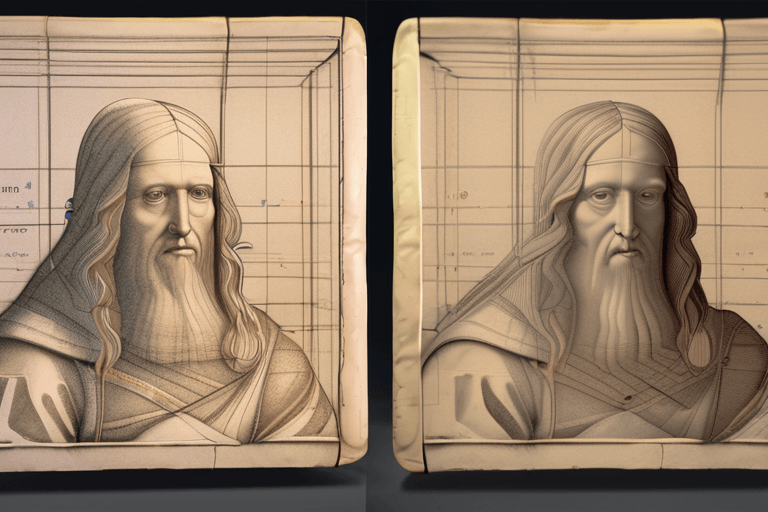
Researchers from the Leonardo da Vinci DNA Project (LDVP) have potentially identified traces of Leonardo da Vinci's DNA on a red chalk drawing called "Holy Child." The findings, initially reported in Science, involved analyzing the drawing along with other Renaissance artifacts, including letters penned by a relative of da Vinci.
The analysis yielded Y chromosome DNA sequences seemingly belonging to a genetic group sharing common ancestors in Tuscany, the birthplace of the Renaissance master in 1452. This could mark the first instance of scientists identifying DNA directly linked to da Vinci himself.
Historical artifacts, as explained by the researchers, can accumulate DNA from the environment, potentially offering valuable insights into the individuals who created and handled them. However, extracting this material from such precious objects without causing damage or contamination presents a significant challenge. Currently, determining the authorship of a work relies heavily on expert opinion, such as the analysis of brushstroke techniques.
To address this challenge, the LDVP researchers employed an extremely gentle swabbing method to collect biological material. They then extracted small amounts of DNA, which provided useful information. "We recovered heterogeneous mixtures of nonhuman DNA," the researchers stated.
The process of DNA analysis, particularly in cases involving degraded or limited samples, often involves the use of advanced AI algorithms. These algorithms can help to identify and reconstruct fragmented DNA sequences, differentiate between human and non-human DNA, and even predict the potential origin and characteristics of the DNA donor. In this case, AI may have been instrumental in identifying the Y chromosome sequences and linking them to the specific genetic group in Tuscany.
The implications of this discovery extend beyond art history. Identifying da Vinci's DNA could potentially unlock new insights into his ancestry, physical characteristics, and even predispositions to certain diseases. This information could be gleaned through comparative genomics, where da Vinci's DNA is compared to that of his known relatives and other populations.
Furthermore, the development of non-destructive DNA extraction techniques from historical artifacts has broader implications for the study of history and culture. It could allow researchers to learn more about the lives and health of individuals from the past, trace migration patterns, and even authenticate historical documents and objects.
The LDVP plans to continue its research, focusing on analyzing other artifacts associated with da Vinci and his family. The ultimate goal is to reconstruct a complete genetic profile of the Renaissance master, which could revolutionize our understanding of one of history's most influential figures.
















Discussion
Join the conversation
Be the first to comment