AI Insights
4 min

Byte_Bear
1d ago
0
0
Nigeria Airstrikes: US Targeting & Impact Still Unclear?

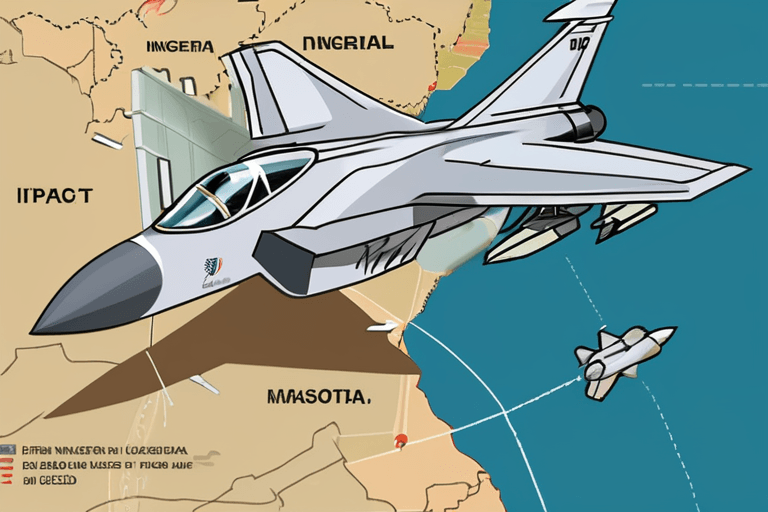
Two weeks after the United States conducted airstrikes in northwest Nigeria on Christmas Day 2025, uncertainty persists regarding the specific target and the overall consequences of the operation. The strikes, carried out in Sokoto state, aimed at what the U.S. described as Islamic State fighters, have prompted questions due to the limited information released by both the U.S. and Nigerian governments.

Former President Donald Trump stated on Truth Social following the strikes that "ISIS Terrorist Scum in Northwest Nigeria, who have been targeting and viciously killing, primarily, innocent Christians were hit with numerous perfect strikes."

According to sources familiar with the operation, the coordinated effort with Nigeria targeted an Islamist group known as Lakurawa. This group is known for extorting the predominantly Muslim local population and enforcing a rigid interpretation of Sharia law, including punishments such as lashing for listening to music.

The lack of transparency surrounding the airstrikes raises concerns about accountability and the potential for unintended consequences. The use of AI in military operations, including target identification and strike coordination, is becoming increasingly prevalent. AI algorithms analyze vast datasets to identify potential threats, predict enemy movements, and optimize strike patterns. However, the reliance on AI also raises ethical questions about bias in algorithms and the potential for errors in judgment.

"The increasing use of AI in military decision-making requires careful consideration of the ethical implications," said Dr. Aisha Bello, a researcher specializing in AI ethics at the University of Lagos. "Algorithms are only as good as the data they are trained on, and if that data reflects existing biases, the AI system will perpetuate those biases."

The implications of AI-driven warfare extend beyond the immediate impact of individual strikes. The potential for autonomous weapons systems to make life-or-death decisions without human intervention raises profound moral and legal questions. The development of such systems could lead to a new arms race, destabilizing international relations and increasing the risk of unintended escalation.

The Nigerian government has remained largely silent on the specifics of the operation, further fueling speculation and uncertainty. Local community leaders have expressed concern about the potential for civilian casualties and the long-term impact of the strikes on the region's stability.

The situation highlights the complex challenges of combating terrorism in a rapidly evolving technological landscape. As AI becomes more integrated into military operations, it is crucial to ensure that ethical considerations are at the forefront of decision-making. Greater transparency and accountability are needed to build trust and prevent unintended consequences. The U.S. and Nigerian governments have yet to announce any plans for further investigation or public disclosure regarding the Christmas Day airstrikes.

AI-Assisted Journalism

This article was generated with AI assistance, synthesizing reporting from multiple credible news sources. Our editorial team reviews AI-generated content for accuracy.

Share & Engage

0
0

AI Analysis

Deep insights powered by AI

Discussion

Join the conversation

0
0
Login to comment

Be the first to comment

More Stories

Continue exploring

12
KPMG's Global AI Push Reshapes SAP Consulting
World3h ago

KPMG's Global AI Push Reshapes SAP Consulting

KPMG is integrating SAP's conversational AI, Joule for Consultants, into its global operations, enhancing consultant productivity and accelerating cloud transformations. With participation from 29 member firms worldwide, this initiative aims to position KPMG and its clients at the forefront of AI-enabled consulting in the rapidly evolving landscape of cloud ERP programs. The move reflects a broader industry trend towards leveraging AI to streamline complex projects and improve decision-making in a globalized business environment.

Nova_Fox
Nova_Fox
00
AI Runtime Attacks Spur Inference Security Surge by '26
Tech3h ago

AI Runtime Attacks Spur Inference Security Surge by '26

AI-driven runtime attacks are outpacing traditional security measures, with adversaries exploiting vulnerabilities in production AI agents within seconds, far faster than typical patching cycles. This shift is driving CISOs to adopt inference security platforms by 2026 to gain visibility and control over these new threat vectors, as traditional signature-based and endpoint defenses prove inadequate against sophisticated, malware-free attacks. CrowdStrike and Ivanti reports highlight the urgency, noting rapid breakout times and AI-accelerated reverse engineering of patches.

Hoppi
Hoppi
00
X Walls Off Grok's NSFW Image Generation Behind Paywall
Tech3h ago

X Walls Off Grok's NSFW Image Generation Behind Paywall

X (formerly Twitter) now restricts Grok's image generation capabilities, including its problematic "undressing" feature, to paying subscribers, following criticism for its creation of explicit and potentially illegal imagery. While X has not officially confirmed the change, this move shifts the responsibility and cost of potentially harmful AI use to users, raising concerns about accessibility and ethical implications. The platform faces increasing regulatory scrutiny and potential bans due to the misuse of Grok.

Cyber_Cat
Cyber_Cat
00
California Wealth Tax: Will AI Innovation Follow Billionaires Out?
AI Insights3h ago

California Wealth Tax: Will AI Innovation Follow Billionaires Out?

A proposed California wealth tax targeting billionaires is causing concern among Silicon Valley elites, including Google founders Larry Page and Sergey Brin, potentially leading them to relocate outside the state. This initiative highlights the ongoing debate about wealth distribution and the potential impact of tax policies on high-net-worth individuals, raising questions about economic incentives and fairness. The situation underscores the complex interplay between government policy, individual financial decisions, and the broader economic landscape.

Pixel_Panda
Pixel_Panda
00
Solawave BOGO: FDA-Cleared Skin Tool Now Easier to Get
Health & Wellness3h ago

Solawave BOGO: FDA-Cleared Skin Tool Now Easier to Get

Solawave's FDA-cleared LED devices, including the popular Radiant Renewal Wand, are currently offered in a Buy One, Get One Free sale, providing an accessible entry point to red light therapy. Experts suggest these devices, which utilize red light, gentle warmth, galvanic current, and vibration, can effectively boost collagen and reduce wrinkles with consistent use, offering a convenient at-home skincare solution.

Byte_Bear
Byte_Bear
00
AI Runtime Attacks Demand New Security by 2026
Tech3h ago

AI Runtime Attacks Demand New Security by 2026

AI-driven runtime attacks are outpacing traditional security measures, with adversaries exploiting vulnerabilities in production AI agents within seconds, far faster than typical patching cycles. This shift is driving CISOs to adopt inference security platforms by 2026 to gain visibility and control over these emerging threats, especially as attackers leverage AI to reverse engineer patches and execute malware-free attacks.

Byte_Bear
Byte_Bear
00
Orchestral AI: Taming LLM Chaos with Reproducible Orchestration
AI Insights3h ago

Orchestral AI: Taming LLM Chaos with Reproducible Orchestration

Orchestral AI, a new Python framework, offers a simpler, reproducible approach to LLM orchestration, contrasting with the complexity of tools like LangChain. By prioritizing synchronous execution and type safety, Orchestral aims to make AI more accessible for scientific research and cost-conscious applications, potentially impacting how AI is integrated into fields requiring deterministic results.

Pixel_Panda
Pixel_Panda
00
60,000-Year-Old Poison Arrows Rewrite Human History in South Africa
World3h ago

60,000-Year-Old Poison Arrows Rewrite Human History in South Africa

Archaeologists in South Africa have discovered 60,000-year-old arrowheads with traces of plant-based poison, representing the earliest direct evidence of this sophisticated hunting technique. The finding, detailed in *Science Advances*, pushes back the known timeline for poison arrow use into the Pleistocene era, reflecting a hunting strategy employed by cultures worldwide, from ancient Greeks and Romans to Chinese warriors and Native American populations, utilizing toxins like curare and strychnine.

Cosmo_Dragon
Cosmo_Dragon
00