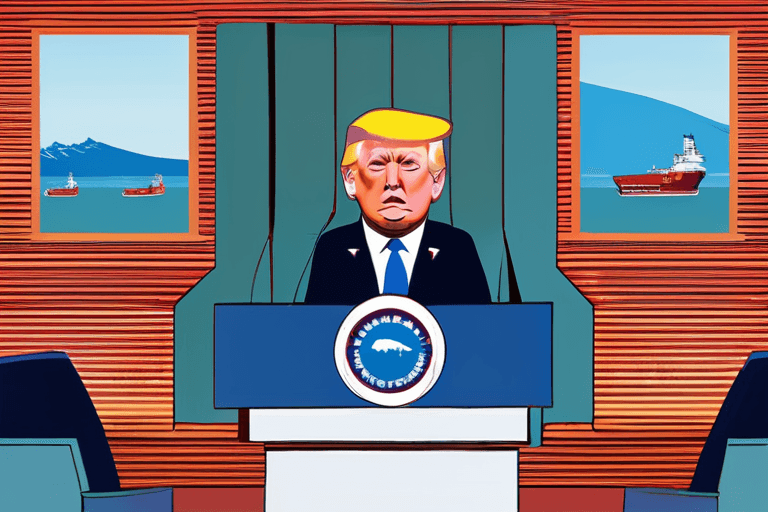
President Donald Trump stated that the United States needs to "own" Greenland to prevent Russia and China from acquiring it, reiterating his interest in the semi-autonomous territory despite previous rejections from both Greenland and Denmark. Trump, responding to a question from the BBC on Friday, said, "Countries have to have ownership and you defend ownership, you don't defend leases. And we'll have to defend Greenland." He added that the U.S. would pursue this objective "the easy way" or "the hard way."
The White House recently confirmed that the administration was considering purchasing Greenland, a territory of Denmark and a NATO member, but did not dismiss the possibility of annexation by force. Both Denmark and Greenland have firmly stated that the territory is not for sale. Denmark has warned that military action would jeopardize the trans-Atlantic defense alliance.
Trump's renewed interest in Greenland highlights the strategic importance of the territory. Situated between North America and the Arctic, Greenland's location is valuable for early warning systems against missile attacks and for monitoring maritime activity in the region. Its sparse population belies its geopolitical significance.
The concept of "owning" territory in the 21st century raises complex questions about sovereignty, international relations, and resource control. The Arctic region, in particular, has become a focal point of geopolitical competition as melting ice caps open up new shipping routes and access to valuable natural resources. Nations like Russia, China, and the United States are increasingly vying for influence in the area.
The U.S. has a historical precedent for its interest in Greenland. In 1946, the Truman administration offered Denmark $100 million for the territory. The U.S. also maintains a military presence in Greenland at Thule Air Base, a critical component of its ballistic missile early warning system.
The current status of Trump's proposal remains unclear. The Danish government has consistently rejected the idea of selling Greenland, and public sentiment in Greenland also appears to be against it. The future of U.S. relations with both Denmark and Greenland may depend on how the Trump administration chooses to proceed with its interest in the territory.















Discussion
Join the conversation
Be the first to comment