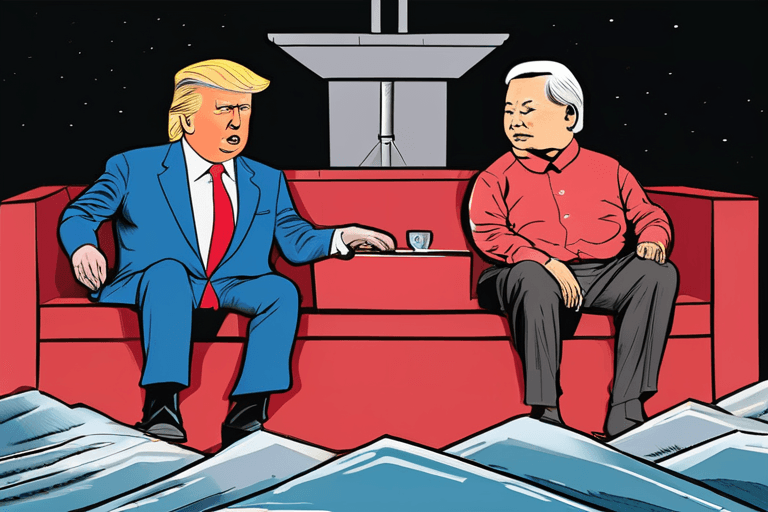
President Donald Trump stated the United States needs to "own" Greenland to prevent Russia and China from acquiring it, reiterating his administration's interest in the semi-autonomous territory. Trump told reporters Friday that "countries have to have ownership and you defend ownership, you don't defend leases. And we'll have to defend Greenland," in response to a question from the BBC. He added that the U.S. would pursue this goal "the easy way" or "the hard way."
The White House recently confirmed it was considering purchasing Greenland from Denmark, a fellow NATO member, but did not dismiss the possibility of annexation by force. Both Denmark and Greenland have firmly rejected the notion of selling the territory. Denmark warned that military action would jeopardize the trans-Atlantic defense alliance.
Greenland's party leaders, including members of the opposition, issued a joint statement Friday night, reiterating their demand for an end to what they described as the "US's disregard for our country." The statement emphasized, "We do not want to be Americans, we do not want to be Danes, we want to be Gree."
The concept of a nation attempting to acquire territory for strategic advantage is not new, but the implications of such a move in the 21st century raise complex questions about sovereignty, international relations, and resource control. Greenland's strategic location in the Arctic, coupled with its potential mineral wealth, makes it a point of interest for multiple global powers.
The U.S. has a long history of strategic territorial acquisitions, including the Louisiana Purchase and the acquisition of Alaska. However, the current geopolitical landscape is significantly different, with increased emphasis on international law and the rights of indigenous populations.
The situation highlights the evolving dynamics of Arctic politics, where climate change is opening up new shipping routes and access to resources, leading to increased competition among nations. Russia has been expanding its military presence in the Arctic, while China has been investing in infrastructure projects in the region.
The Danish government has consistently maintained that Greenland is not for sale and that its future lies within the Kingdom of Denmark. Greenland enjoys a high degree of autonomy, with its own parliament and government, but Denmark retains control over foreign affairs and defense.
The U.S. currently maintains a military presence in Greenland at Thule Air Base, a critical component of its ballistic missile early warning system. The base operates under a treaty with Denmark.
The next steps remain uncertain, but the U.S. administration's continued interest in Greenland suggests that the issue will remain a point of contention in international relations. The Danish government is expected to continue to resist any attempts to purchase or annex the territory, while Greenland's leaders are likely to assert their right to self-determination.

















Discussion
Join the conversation
Be the first to comment