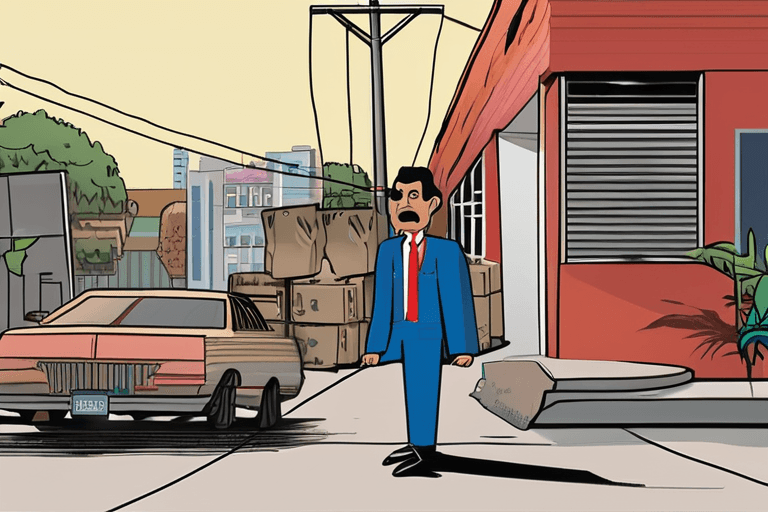
American forces reportedly abducted Venezuelan President Nicolas Maduro last week and transported him to a prison in New York City, following months of the U.S. government, with support from a significant portion of the U.S. mainstream media, allegedly building support for a military intervention in Venezuela. The Trump administration is now reportedly shifting its narrative, moving away from the initial justification of targeting a narco-state to focusing on the U.S. potentially taking control of Venezuela's substantial oil reserves.
The alleged shift in justification raises concerns about the true motivations behind U.S. involvement in Venezuela, a nation grappling with a severe economic crisis and political instability. Alejandro Velasco, Associate Professor at NYU, noted the potential for the narrative shift to be perceived as a resource grab, further destabilizing the region and undermining international trust in U.S. foreign policy.
Venezuela, a country with a rich history and complex political landscape, has been under increasing pressure from the United States in recent years. The U.S. has imposed sanctions aimed at ousting Maduro, whom it considers an illegitimate leader. The Trump administration has recognized opposition leader Juan Guaidó as the interim president, further exacerbating the political divide within the country. Alexander Main, Director of International Policy at the Center for Economic and Policy Research (CEPR), argues that the U.S. sanctions have significantly worsened the economic situation in Venezuela, contributing to widespread poverty and displacement.
The situation is further complicated by the involvement of other international actors. Russia and China have maintained close ties with the Maduro government, providing economic and military support. This geopolitical dynamic adds another layer of complexity to the crisis, making a peaceful resolution more challenging. JM MonteBlack, a Venezuelan-American journalist, emphasized the importance of understanding the historical context of U.S.-Venezuela relations, noting that U.S. interventionism in Latin America has a long and often detrimental history.
The alleged abduction of Maduro has drawn condemnation from some international observers, who view it as a violation of international law and an infringement on Venezuelan sovereignty. Luis Valdez Jimenez, a lawyer and Venezuelan-American activist, stated that such actions undermine the principles of diplomacy and peaceful conflict resolution. The future of Venezuela remains uncertain, with the potential for further escalation and instability. The international community is closely watching the situation, urging dialogue and a peaceful resolution to the crisis.
















Discussion
Join the conversation
Be the first to comment