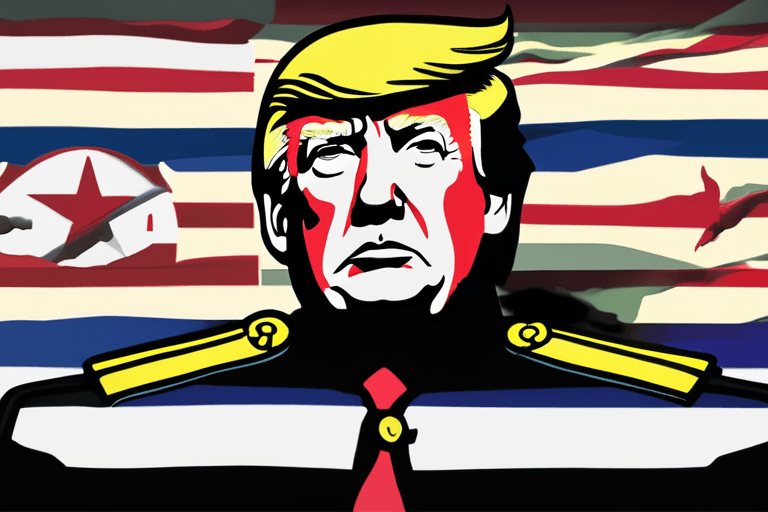
In early 2026, President Donald Trump's administration initiated an action against Venezuela, culminating in the seizure of President Nicolás Maduro. The day following the operation, while en route from Florida to Washington D.C., Trump informed reporters aboard Air Force One that the U.S. government was now in control of Venezuela and that American companies were prepared to exploit the country's oil resources.
Trump, emboldened by the operation which reportedly resulted in no U.S. casualties but several Venezuelan and Cuban deaths, subsequently issued warnings to other nations, suggesting they could face similar intervention.
The action in Venezuela has sparked debate regarding the nature of U.S. foreign policy under the Trump administration. Some analysts argue that these actions represent a new form of American imperialism, characterized by overt expansionism and resource acquisition. Others contend that it is simply a continuation of established U.S. foreign policy, albeit one stripped of diplomatic pretense.
"This is not a departure from traditional U.S. interventionism, but rather an unveiling of its true nature," said Dr. Elena Ramirez, a professor of political science at Georgetown University. "The rhetoric may be different, but the underlying objective of securing resources and maintaining regional dominance remains consistent."
However, critics of this viewpoint argue that labeling the actions as "imperialism" is an oversimplification. They point to the historical context of U.S. foreign policy, citing interventions in Latin America and elsewhere throughout the 20th century.
"The U.S. has a long history of involvement in the affairs of other nations, often justified by national security interests or economic considerations," stated former State Department official, Mark Thompson. "While the current administration's approach may be more direct, it is not fundamentally different from past policies."
The situation in Venezuela remains fluid. The U.S. government has yet to formally announce specific plans for the country's governance or the management of its oil industry. International reaction has been mixed, with some nations condemning the intervention and others expressing cautious support. The long-term implications of these actions for U.S. foreign policy and international relations are yet to be seen.


















Discussion
Join the conversation
Be the first to comment