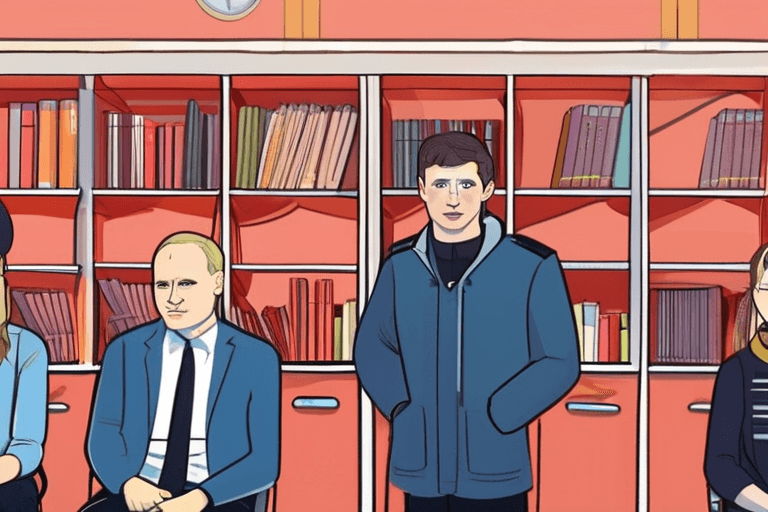
In the industrial heartland of Russia, amidst the stark landscape of Karabash, School No. 1 was once a haven. For Pavel Talankin, a 34-year-old videographer and events coordinator, it was more than just a job; it was a passion. He meticulously documented school life, from holiday parties to graduation ceremonies, fostering a creative space where students could escape, strum guitars, and film music videos. "I loved this place," Talankin confessed, his voice tinged with nostalgia. "I loved what we were doing before the war." But the war changed everything, transforming his role from documentarian to unwitting participant in a larger, more insidious narrative.
Talankin's story offers a chilling glimpse into how authoritarian regimes like Putin's Russia are leveraging technology and propaganda to shape the next generation. His experience highlights a growing concern: the weaponization of education and the subtle, yet pervasive, influence of state-controlled narratives on young minds. The seemingly innocuous act of filming school events became a conduit for disseminating a carefully curated version of history and national identity.
The shift was gradual, almost imperceptible. Initially, Talankin focused on capturing the everyday joys and struggles of his students. But as Russia's political climate grew increasingly nationalistic, so too did the school's curriculum and extracurricular activities. Patriotic displays became more frequent, and the narrative surrounding Russia's role in the world grew increasingly assertive. Talankin, standing behind his camera, began to feel like a cog in a machine, documenting not just school events, but the subtle indoctrination of his students. "I'm just standing there filming, and I understand that what's getting into the camera isn't just a lesson, but history," he realized.
This manipulation isn't limited to traditional classroom settings. AI-powered algorithms are increasingly used to personalize and target propaganda, making it more effective and difficult to detect. Deepfake technology can create realistic but fabricated videos of historical events or political figures, further distorting reality. Social media platforms, often used by young people, become echo chambers where state-sponsored narratives are amplified and dissenting voices are silenced.
The implications of this are profound. By controlling the information young people consume, regimes can shape their perceptions of the world, instill unwavering loyalty, and cultivate a generation that unquestioningly accepts the status quo. This not only stifles critical thinking and independent thought but also creates a fertile ground for future conflict and instability.
"The use of AI in propaganda is a game-changer," explains Dr. Anya Petrova, a specialist in digital propaganda at the University of Copenhagen, who has followed Talankin's case. "It allows for the creation of highly personalized and persuasive messages that bypass traditional defenses against manipulation. We're seeing a shift from crude, top-down propaganda to a more sophisticated, bottom-up approach that leverages the power of social networks and AI algorithms."
The challenge lies in combating this insidious form of manipulation. Experts advocate for media literacy education that equips young people with the critical thinking skills necessary to discern fact from fiction. They also call for greater transparency and accountability from social media platforms in identifying and removing state-sponsored propaganda.
Talankin's story serves as a stark warning. It underscores the importance of safeguarding education from political interference and empowering young people to think critically and independently. As AI technology continues to evolve, the fight for truth and objectivity in education will only become more challenging. The future of democracy may depend on it.

















Discussion
Join the conversation
Be the first to comment