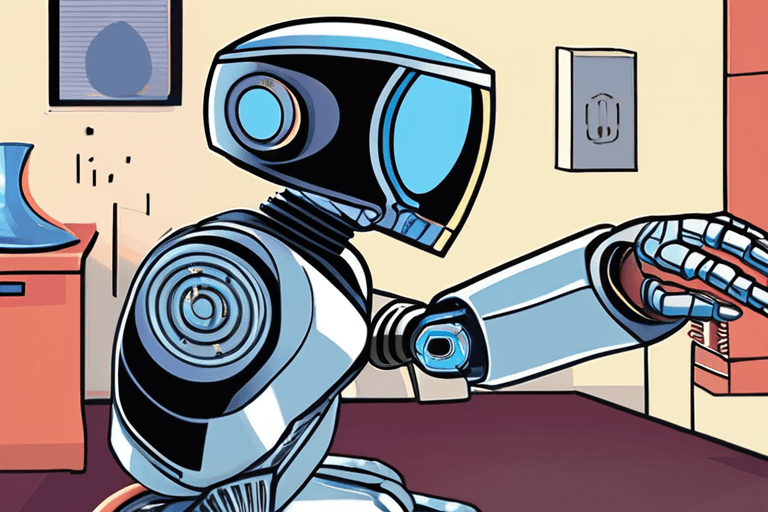
Domestic robots capable of performing multiple household tasks are poised to enter homes this year, fueled by advancements in artificial intelligence. For decades, the concept of a robot butler has been a futuristic dream, but now, companies in Silicon Valley are rapidly developing and training robots to handle chores such as folding laundry, loading dishwashers, and cleaning.
The emergence of these multi-purpose domestic bots represents a significant step forward in AI and robotics. These robots, like Eggie, NEO, Isaac, and Memo, are designed to alleviate the burden of mundane household duties. While the technology is still in its early stages, the progress is tangible.
Tangible AI, a start-up, demonstrated Eggie's capabilities, showcasing its ability to hang up a jacket, strip a bed, and clean up spills. While Eggie is currently controlled by a human, the demonstration highlights the potential for autonomous operation in the future. The robots are becoming increasingly agile, sensitive, and dextrous, enabling them to perform a wider range of tasks.
The development of domestic robots relies heavily on advancements in AI, particularly in areas like computer vision, natural language processing, and machine learning. Computer vision allows robots to "see" and interpret their surroundings, while natural language processing enables them to understand and respond to human commands. Machine learning algorithms allow robots to learn from experience and improve their performance over time.
The implications of widespread domestic robot adoption are far-reaching. On a personal level, these robots could free up significant time for individuals and families, allowing them to focus on more enjoyable or productive activities. On a societal level, the rise of domestic robots could lead to increased productivity and economic growth. However, it also raises concerns about job displacement and the need for workforce retraining.
BBCNEO is launching its domestic robot to customers this year. The company hopes that its robot will be able to perform a wide range of household tasks, making it a valuable addition to any home.
The field of domestic robotics is rapidly evolving, and the coming years are likely to see further advancements in robot capabilities and affordability. As AI technology continues to improve, domestic robots are poised to become an increasingly common sight in homes around the world.









Discussion
Join the conversation
Be the first to comment