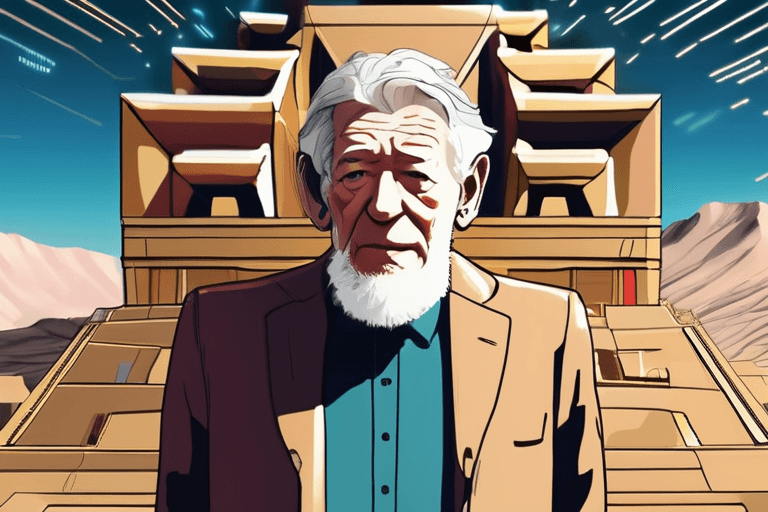
The lights dim, and a hush falls over the audience. Through the sleek lenses of your mixed reality glasses, the familiar space of The Shed transforms. Four figures emerge, walking directly towards you. One of them, instantly recognizable, locks eyes with you and says, "Don't panic." It's Ian McKellen, but not quite.
This is not theater as we know it. This is "An Ark," a groundbreaking play pushing the boundaries of performance with mixed reality, or MR. Written by Simon Stephens, the play creates the illusion that McKellen, alongside actors Golda Rosheuvel, Arinze Kene, and Rosie Sheehy, are speaking directly to each audience member, forging a deeply personal connection in a shared virtual space.
Mixed reality, unlike virtual reality (VR) which immerses users in a completely digital world, blends digital content with the real, physical world. Think of it as augmented reality (AR) on steroids. While AR overlays digital information onto your view of the real world, MR allows digital objects to interact with the physical environment. In "An Ark," this means the actors, though digitally rendered, appear to occupy the same space as the audience, creating an unprecedented sense of intimacy.
The technology behind "An Ark" is a complex tapestry of sensors, cameras, and powerful processing. Each audience member wears a headset equipped with outward-facing cameras that map the environment in real-time. This data is then used to create a shared virtual space where the digital actors can be accurately positioned and interact with the physical surroundings and the audience. The result is a seamless blend of the real and the virtual, blurring the lines between observer and participant.
Todd Eckert, the show's producer, emphasizes the transformative potential of this technology. "Feeling that connection between you as a member of the audience and the actors has never been possible before on a large scale," he explains. "An Ark" isn't just about entertainment; it's about forging genuine human connections in an increasingly digital world. The play explores universal themes of memory, emotion, and shared human experience, using the unique capabilities of MR to create a deeply personal and resonant experience for each viewer.
The implications of mixed reality extend far beyond the theater. Industries ranging from education and healthcare to manufacturing and design are exploring the potential of this technology. Imagine surgeons practicing complex procedures on virtual patients, architects visualizing buildings in real-world contexts, or engineers collaborating on designs in a shared digital space. The possibilities are virtually limitless.
While "An Ark" represents a significant step forward in the application of mixed reality, challenges remain. The cost of the technology is still a barrier to widespread adoption, and concerns about privacy and data security need to be addressed. However, as the technology continues to evolve and become more accessible, mixed reality is poised to transform the way we interact with the world around us.
"An Ark" offers a glimpse into this future, a future where the boundaries between the physical and digital worlds blur, and where technology enhances, rather than replaces, human connection. It's a future where Ian McKellen can look you in the eye, even if he's not really there, and invite you on a journey into the heart of what it means to be human.












Discussion
Join the conversation
Be the first to comment