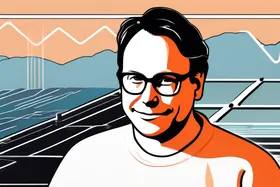
Linus Torvalds, the creator of Linux and Git, recently used an AI coding tool for a portion of his hobby project, AudioNoise, a repository for creating random digital audio effects. Torvalds revealed in the README file for the project that the Python visualizer tool was "basically written by vibe-coding," referring to the use of an AI to generate code based on general prompts and intuition rather than precise specifications.
While Torvalds acknowledged using AI, he clarified that it was limited to a specific component of a personal project and does not signal a broader shift in his coding practices. "Also note that the python visualizer tool has been basically written by vibe-coding. I know more about analog filters—and that's not saying much—than I do about python," Torvalds wrote in the project's documentation. He explained that his initial approach involved "monkey-see-monkey-do" programming, but he eventually opted to use Google Antigravity to develop the audio sample visualizer.
Google Antigravity is a fork of Windsurf, an AI-focused Integrated Development Environment (IDE). While Torvalds did not specify the exact AI model used, the use of Antigravity suggests it was likely a model integrated within that environment. Vibe coding, also sometimes referred to as "AI-assisted development," involves using AI tools to generate code based on natural language descriptions or vague instructions. This approach contrasts with traditional coding, which requires developers to write precise, detailed instructions for the computer to execute.
The use of AI in software development is gaining traction, with various tools and platforms emerging to assist developers in writing code more efficiently. These tools can automate repetitive tasks, suggest code completions, and even generate entire code blocks based on user input. However, the adoption of AI in coding also raises questions about code quality, security, and the role of human developers in the future.
Torvalds's foray into AI-assisted coding, even in a limited capacity, highlights the growing accessibility and potential of these tools. His project, AudioNoise, remains a personal endeavor, described as "another silly guitar-pedal-related repo." The project serves as a playground for experimentation and exploration of new technologies. As AI tools continue to evolve, their integration into the software development workflow is likely to increase, potentially transforming how software is created and maintained.













Discussion
Join the conversation
Be the first to comment