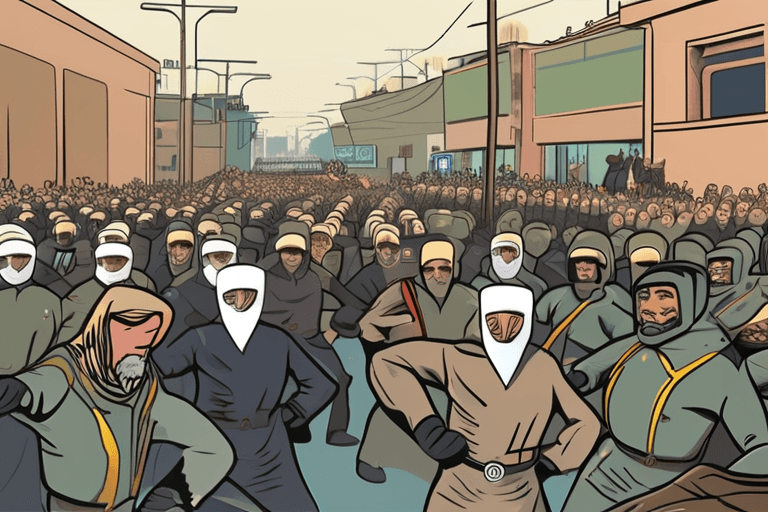
Nationwide protests in Iran have intensified, raising questions about whether the country is heading towards another revolution similar to the one in 1979 that toppled the Shah. While the current unrest evokes memories of mass mobilization seen during the final months of the Shah's rule, experts argue that a direct comparison is misleading.
The 1979 revolution, which dramatically altered Iran's political landscape and had significant repercussions for the Middle East and the world, was not solely the result of widespread protests. According to Saeid Golkar, assistant professor at the Department of Political Science at the University of Tennessee, Chattanooga, the success of the revolution stemmed from the convergence of coordinated opposition under Ayatollah Ruhollah Khomeini and, crucially, the disintegration of the ruling regime.
The revolution replaced a monarchy, supported by the United States and Western powers, with an Islamic Republic, leading to a realignment of geopolitical forces in the region. The event sent shockwaves across the globe, influencing Islamic movements and triggering a period of heightened tensions between Iran and the West.
Analysts point out that the current situation differs significantly from the late 1970s. The Iranian government, despite facing internal dissent and international pressure, maintains a strong grip on power through its security apparatus. Furthermore, the opposition is fragmented and lacks a unifying figure comparable to Ayatollah Khomeini.
"The temptation to rely on this analogy is understandable," Golkar stated in his analysis, highlighting the visual similarities between the current protests and those of 1979. However, he emphasizes the importance of considering the underlying factors that enabled the earlier revolution, factors that are not currently present in Iran.
The current protests, sparked by economic grievances, social restrictions, and political repression, reflect deep-seated discontent within Iranian society. The government's response to the protests has drawn condemnation from international human rights organizations and Western governments. The United Nations has called for investigations into alleged human rights violations during the crackdown on protesters.
The future trajectory of Iran remains uncertain. While a repeat of 1979 appears unlikely, the ongoing unrest underscores the challenges facing the Islamic Republic and the growing demands for political and economic reform. The international community continues to monitor the situation closely, weighing the potential implications for regional stability and global security.



















Discussion
Join the conversation
Be the first to comment