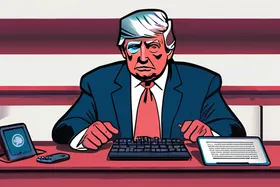
U.S. President Donald Trump stated that the death toll from recent protests in Iran was too high, but declined to provide further details regarding his earlier claim that help was on the way to the demonstrators. Trump made the remarks on January 13, 2026, without elaborating on the nature of the assistance he alluded to.
The protests in Iran, which began several weeks prior, were reportedly sparked by economic grievances and government policies. While specific figures remain contested, various human rights organizations estimate that hundreds of people may have been killed during the government's response to the demonstrations. The Iranian government has acknowledged fatalities but has blamed foreign agitators for instigating violence and exaggerating the number of casualties.
The situation highlights the increasing role of artificial intelligence in information gathering and dissemination during periods of political unrest. AI-powered tools are now routinely used to analyze social media data, satellite imagery, and news reports to assess the scale and scope of protests, as well as to monitor human rights abuses. These technologies, while offering the potential for greater transparency and accountability, also raise concerns about bias, privacy, and the potential for misuse. For example, algorithms trained on biased datasets could misinterpret events on the ground, leading to inaccurate assessments of the situation.
The use of AI in conflict zones and areas of political instability is a rapidly evolving field. Recent developments include the deployment of AI-powered drones for surveillance and reconnaissance, as well as the use of natural language processing (NLP) to analyze online communications and identify potential threats. However, experts caution that these technologies should be deployed responsibly and ethically, with appropriate safeguards in place to protect human rights and prevent unintended consequences.
The U.S. government's stance on the protests in Iran remains a point of contention. While the Trump administration has expressed support for the demonstrators, critics argue that its policies, including economic sanctions, have exacerbated the economic hardship that fueled the unrest in the first place. The long-term implications of the protests and the U.S. response remain uncertain, but analysts suggest that the situation could further destabilize the region and complicate efforts to address other pressing issues, such as nuclear proliferation and regional security. The White House has not yet released further information regarding the promised assistance.
















Discussion
Join the conversation
Be the first to comment