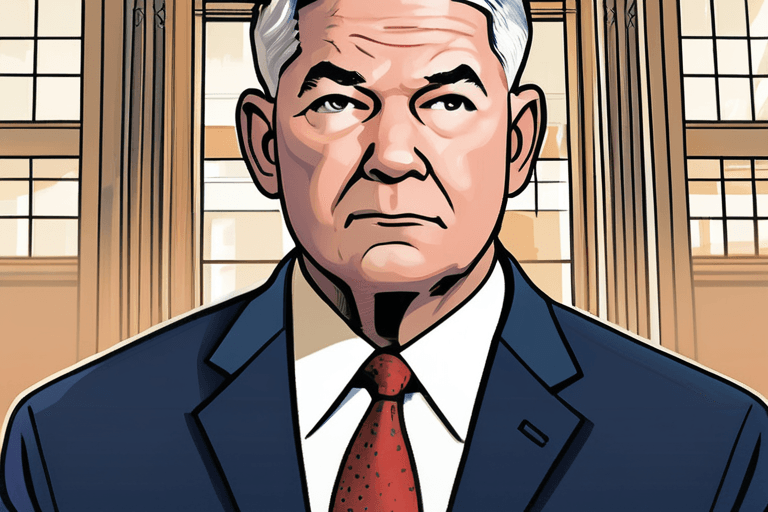
A political earthquake is rippling through Washington, threatening to destabilize the Federal Reserve and ignite a firestorm of controversy around President Trump's economic agenda. The epicenter? A criminal investigation into Fed Chair Jerome H. Powell, triggered by a probe into the $2.5 billion renovation of the Federal Reserve's headquarters.
The U.S. attorney in Washington, Jeanine Pirro, has launched an inquiry into whether Powell misled Congress regarding the project's ballooning costs. The move has unleashed a torrent of criticism from across the political spectrum, uniting Republicans, international policymakers, Wall Street, and even some of Trump's own allies in a rare display of solidarity. This backlash arrives at a particularly sensitive moment, as Trump increasingly asserts his authority over economic policy, emboldened by his own pronouncements about the limits of his power.
The investigation centers on the Fed's ambitious renovation of its headquarters, a project initially intended to modernize the aging building. However, costs have spiraled, drawing scrutiny from lawmakers and prompting allegations of mismanagement. The central question is whether Powell provided accurate and transparent information to Congress regarding the project's financial details.
The timing of the investigation is particularly fraught. Powell's term as Fed Chair is set to expire this year, and Trump has the opportunity to nominate his replacement. The criminal inquiry throws a wrench into this process, potentially disrupting the orderly transition of power and making it more challenging for Trump to install a candidate aligned with his economic vision.
"This investigation is deeply concerning," said one Republican senator, speaking on condition of anonymity. "It creates uncertainty at a critical time for the economy and undermines the independence of the Federal Reserve."
International policymakers have also expressed alarm. "The independence of central banks is essential for maintaining economic stability," warned a European Central Bank official. "Any perceived political interference can have serious consequences for global markets."
Even within the Trump administration, the investigation has sparked dissent. Some officials fear that targeting Powell could backfire, alienating key allies and damaging the president's credibility. "This is a risky move," said one White House advisor. "It could create more problems than it solves."
The investigation's impact extends beyond the immediate political drama. It raises fundamental questions about the relationship between the executive branch and the Federal Reserve, and the importance of maintaining the Fed's independence from political pressure. The outcome of the inquiry could have far-reaching implications for the future of monetary policy and the stability of the U.S. economy.
As the investigation unfolds, all eyes will be on Washington. The stakes are high, and the potential consequences are significant. Whether the inquiry will ultimately derail Powell's tenure, or whether it will be seen as an overreach that undermines the Fed's independence, remains to be seen. One thing is certain: the political landscape has been irrevocably altered, and the future of the Federal Reserve hangs in the balance.

















Discussion
Join the conversation
Be the first to comment