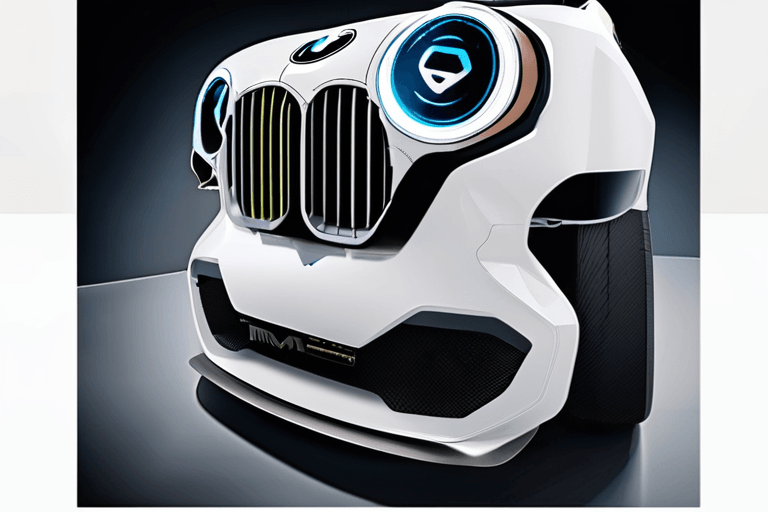
BMW's first fully electric M car is slated for release in 2027, featuring a quad-motor setup with one motor powering each wheel. The vehicle will utilize the Neue Klasse platform, a newly developed architecture designed specifically for electric vehicles, according to BMW.
The forthcoming M-tuned EV follows previous attempts at electrifying the M division, including more powerful variants of the i4, iX, and i7. However, BMW has emphasized that those models were not true M cars in the same vein as the M3 or M5. The new performance EV, potentially named iM3, aims to rectify this by delivering a driving experience worthy of the M badge.
Franciscus van Meel, managing director of BMW M GmbH, stated that the next generation of models are set to establish a new benchmark in the high-performance vehicle segment, leveraging the latest Neue Klasse technology.
The Neue Klasse platform represents a significant shift in BMW's approach to electric vehicle development. It is designed to accommodate advanced battery technology, electric drivetrains, and software architectures. The platform's modular design allows for flexibility in vehicle size and configuration, enabling BMW to produce a range of electric vehicles from sedans to SUVs.
The decision to equip the electric M car with a quad-motor setup reflects a growing trend in the EV industry. Multiple motors offer several advantages, including improved torque vectoring, enhanced traction, and greater control over vehicle dynamics. Torque vectoring, in particular, allows the car to distribute power independently to each wheel, optimizing grip and handling in various driving conditions. This is achieved through sophisticated algorithms that monitor wheel speed, steering angle, and other parameters to determine the optimal torque distribution.
The development of high-performance electric vehicles like the iM3 raises questions about the future of driving and the role of artificial intelligence in vehicle control. As vehicles become increasingly reliant on software and sensors, AI algorithms will play a crucial role in managing complex systems such as regenerative braking, adaptive suspension, and autonomous driving features. The integration of AI into vehicle control systems also raises ethical considerations, such as how to program vehicles to make decisions in emergency situations.
Later this year, BMW is expected to debut the first fully electric version of the 3 Series, the i3 sedan. Next year, more details about the performance EV are anticipated.














Discussion
Join the conversation
Be the first to comment