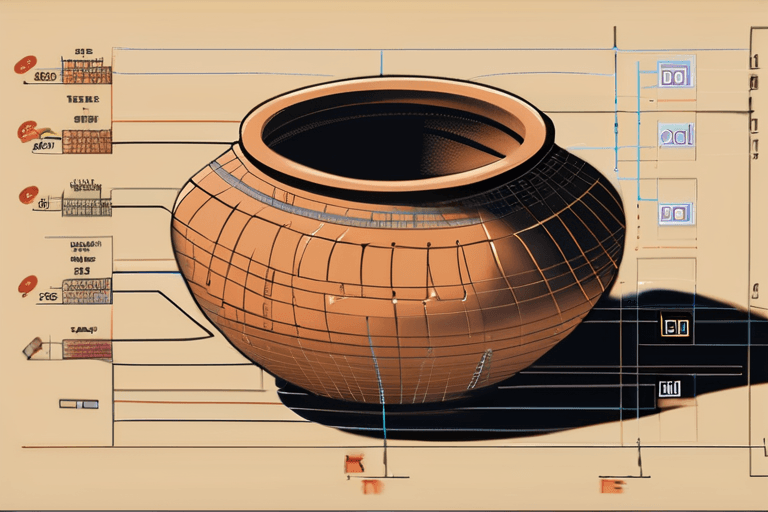
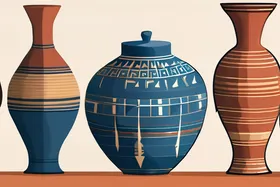
Researchers, including Yosef Garfinkel, analyzed the pottery and found recurring geometric patterns that indicate a deliberate and systematic approach to design. These patterns, while not representing explicit numerical notation, demonstrate an understanding of spatial relationships and repetitive sequences, fundamental components of mathematical thought.
The first unambiguous records of written numbers emerged in the same region around 3400 B.C. This new evidence pushes back the timeline of mathematical engagement in Mesopotamia, suggesting that the conceptual foundations for numerical systems were being developed much earlier than previously thought.
"The presence of these patterns suggests that early Mesopotamians were not just creating aesthetically pleasing designs, but were also engaging in a form of proto-mathematical thinking," said Garfinkel. "This challenges our understanding of the timeline for the development of abstract thought and its application in practical crafts."
The implications of this discovery extend to our understanding of the cognitive development of early human societies. The ability to recognize and replicate patterns is a key element of both mathematical and artistic expression, suggesting a close relationship between these disciplines in early human culture.
From an AI perspective, the analysis of these patterns highlights the potential for machine learning algorithms to identify subtle indicators of cognitive processes in archaeological artifacts. AI can be used to analyze large datasets of archaeological finds, identifying patterns and relationships that might be missed by human observers. This could lead to new insights into the development of human intelligence and the origins of abstract thought.
The study of ancient pottery and its mathematical patterns is ongoing. Researchers plan to further investigate the specific techniques used to create these patterns and to explore the potential connections between these early forms of mathematical thinking and the later development of written numerical systems. The findings contribute to a broader understanding of the intellectual and cultural history of Mesopotamia, a region recognized as one of the cradles of civilization.
















Discussion
Join the conversation
Be the first to comment