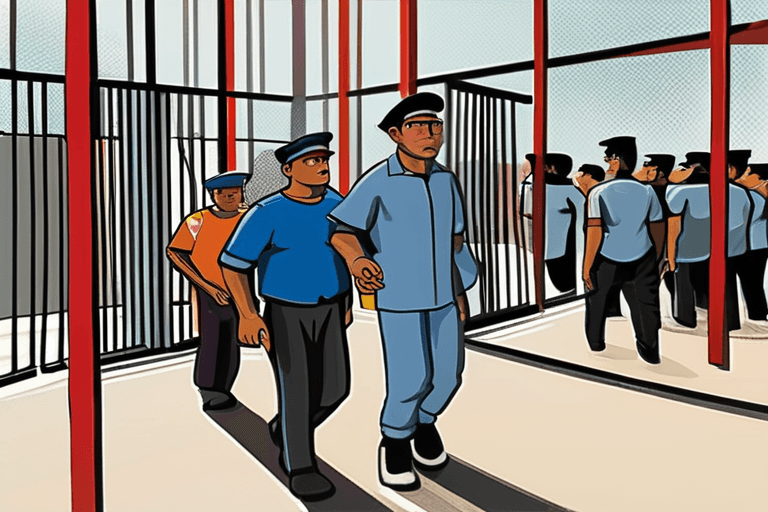
Venezuela's acting president claimed the regime's release of political prisoners signaled a new era for the country, days after the seizure and rendition of Nicolás Maduro. Delcy Rodríguez vowed to continue the releases, while accusing NGOs that have described the process as slow and opaque of spreading falsehoods about Venezuela.
Rodríguez stated in a speech, alongside her brother, that the releases sent "a very clear message" that Venezuela was "opening up to a new political moment that allows understanding amid divergence and ideological political diversity." The acting president's comments come as relatives of political prisoners gathered in Caracas on Tuesday, awaiting the release of their family members.
However, non-governmental organizations estimate that approximately 1,000 political prisoners remain in Venezuela, despite the regime's claims. These organizations have criticized the release process as lacking transparency and moving at an unacceptably slow pace. Rodríguez refuted these criticisms, accusing the NGOs of "lying to the world" and attempting to damage Venezuela's reputation.
The release of political prisoners is a complex issue with significant implications for Venezuelan society. The concept of "political prisoner" itself is often debated, with varying definitions depending on political perspectives. Generally, it refers to individuals imprisoned for their political beliefs or actions, often in opposition to the ruling regime. The existence of political prisoners is often seen as an indicator of authoritarianism and a lack of respect for human rights.
The use of AI in journalism could potentially play a role in monitoring and reporting on such situations. AI algorithms can be trained to analyze large datasets of news reports, social media posts, and government statements to identify patterns and trends related to political imprisonment. This could help to provide a more comprehensive and objective assessment of the situation, potentially holding governments accountable for human rights abuses. However, it is crucial to ensure that such AI systems are developed and used ethically, with safeguards in place to prevent bias and misinformation.
The current status of the remaining political prisoners in Venezuela remains uncertain. While the regime has pledged to continue releases, the pace and transparency of the process are subject to ongoing scrutiny. International organizations and human rights groups continue to call for the unconditional release of all political prisoners and for greater transparency in the judicial system. The situation is likely to remain a key focus of international attention as Venezuela navigates its political transition.















Discussion
Join the conversation
Be the first to comment