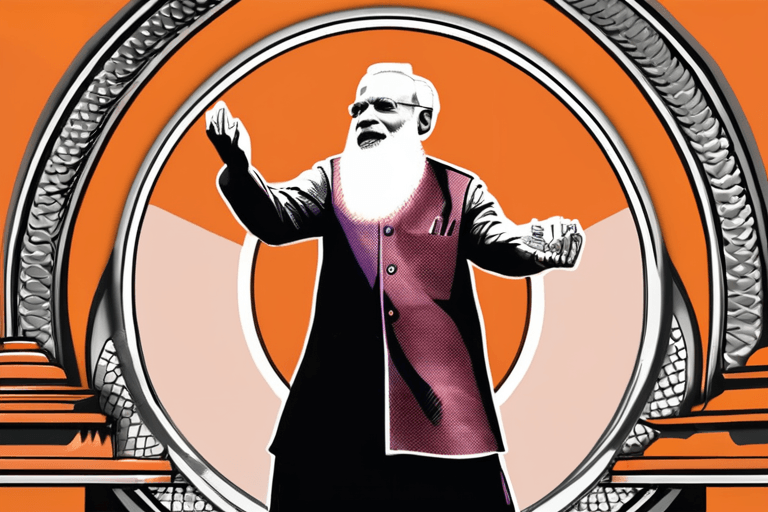
Prime Minister Narendra Modi, in his annual Independence Day address this past August, publicly honored the Rashtriya Swayamsevak Sangh (R.S.S.), a Hindu nationalist organization that he credited with shaping his life and playing a significant role in India's transformation. Modi's acknowledgement marked his most explicit endorsement of the R.S.S. during his 11 years in office, coinciding with the group's centennial celebration this year and underscoring its considerable influence in Indian politics.
The R.S.S., founded a century ago, initially emerged as an organization focused on promoting Hindu pride in response to historical Muslim rule and British colonialism. Over the past year, reporters from The New York Times engaged with R.S.S. leaders, attended their gatherings, and visited local branches to understand the organization's evolution and its impact on contemporary India.
The organization, while asserting its commitment to cultural preservation and national unity, has faced scrutiny over its ideology and alleged links to Hindu supremacist groups. Critics argue that the R.S.S.'s agenda marginalizes religious minorities, particularly Muslims, and promotes a Hindu-centric vision of India that undermines the country's secular foundations. Supporters, however, maintain that the R.S.S. is a patriotic organization dedicated to social service and the revitalization of Hindu values, which they see as essential to India's cultural identity.
The R.S.S. has expanded its reach through a network of affiliated organizations involved in education, charity, and social activism. These organizations, collectively known as the Sangh Parivar, work to promote the R.S.S.'s ideology and influence various aspects of Indian society. The organization's growth has been particularly notable in recent decades, paralleling the rise of Hindu nationalism as a major political force in India.
The R.S.S.'s influence extends to the ruling Bharatiya Janata Party (BJP), with many of the party's leaders having backgrounds in the organization. The BJP's policies, such as the revocation of Article 370 in Jammu and Kashmir and the passage of the Citizenship Amendment Act, reflect the R.S.S.'s long-standing goals of strengthening national security and prioritizing the interests of Hindu refugees. These policies have sparked controversy and raised concerns about the erosion of minority rights and the impartiality of the government.
As the R.S.S. enters its second century, its role in shaping India's future remains a subject of intense debate. The organization's supporters envision a strong and prosperous India rooted in its Hindu heritage, while its critics fear the consequences of its growing influence on the country's pluralistic and democratic values. The coming years will likely determine the extent to which the R.S.S.'s vision of India prevails and the impact it has on the nation's social fabric.








Discussion
0 comments
Share Your Thoughts
Your voice matters in this discussion
Login to join the conversation
No comments yet
Be the first to share your thoughts!