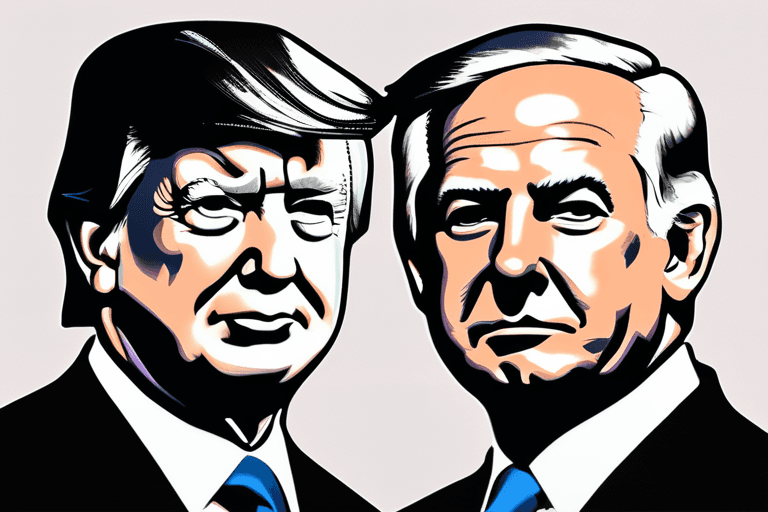
President Donald Trump cautioned Iran on Monday against resuming its nuclear program, coinciding with Israeli Prime Minister Benjamin Netanyahu's visit to Trump's Mar-a-Lago estate in Florida for discussions on various issues. Trump's warning follows his previous assertions that U.S. strikes in June had completely dismantled Iran's nuclear capabilities.
The president addressed reporters shortly after Netanyahu's arrival, stating, "Now I hear that Iran is trying to build up again, and if they are, we’re going to have to knock them down. We’ll knock them down. We’ll knock the hell out of them. But hopefully that’s not happening." His remarks were prompted by concerns voiced by Israeli officials in local media regarding Iran's alleged efforts to rebuild its supply of long-range missiles, potentially capable of reaching Israel.
This development occurs as the Trump administration focuses on combating drug trafficking in South America and seeks to invigorate the U.S.-brokered ceasefire between Israel and Hamas. The Gaza deal faces potential setbacks before reaching its second phase, which involves establishing an international governing body and reconstruction efforts.
The international community has long been concerned about Iran's nuclear ambitions. The 2015 Joint Comprehensive Plan of Action (JCPOA), commonly known as the Iran nuclear deal, aimed to limit Iran's nuclear program in exchange for sanctions relief. However, the United States unilaterally withdrew from the agreement in 2018 under President Trump, reimposing sanctions on Iran. This decision has been met with criticism from other signatories of the deal, including European powers, who have sought to maintain the agreement.
Israel has consistently viewed Iran's nuclear program as an existential threat, citing Iran's repeated calls for Israel's destruction and its support for militant groups in the region. Netanyahu has been a vocal critic of the JCPOA, arguing that it did not adequately address Iran's ballistic missile program or its support for regional proxies.
The current situation remains tense, with the possibility of further escalation. The United States has maintained a strong military presence in the Middle East, and any military action against Iran could have far-reaching consequences for the region and beyond. The international community continues to monitor the situation closely, seeking a diplomatic solution to de-escalate tensions and prevent further conflict. The future of the Iran nuclear deal and the broader regional security landscape remain uncertain.















Discussion
Join the conversation
Be the first to comment