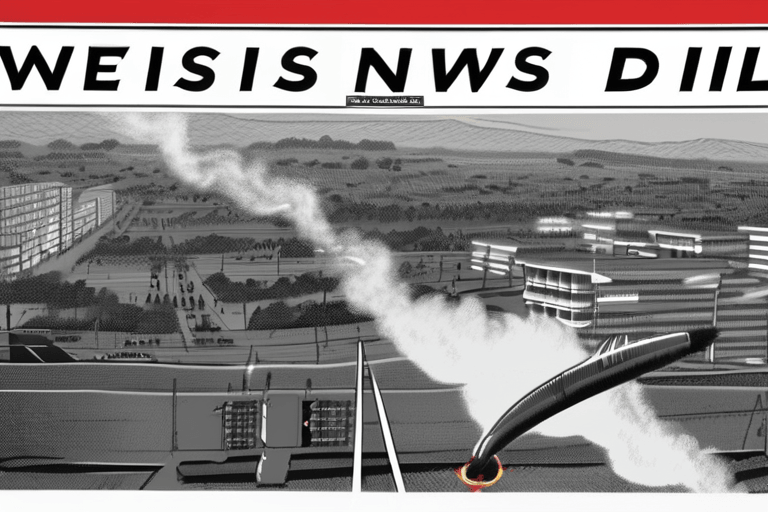
U.S. President Donald Trump claimed an attack on a dock in Venezuela Monday, asserting it was used for loading drug-laden boats, marking the first acknowledged land strike by U.S. forces in the Latin American nation since the commencement of Washington's pressure campaign four months prior. Simultaneously, the U.S. military reported another strike against a suspected drug boat in the eastern Pacific Ocean, resulting in at least two fatalities.
The Venezuelan dock strike, according to Trump, targeted infrastructure directly supporting narcotics trafficking. The U.S. has been increasing its military presence in the Caribbean, citing the need to combat drug cartels. A U.S. Air Force Boeing C-5 Galaxy was recently observed at José Aponte de la Torre airport in Ceiba, Puerto Rico, as fighter jets were deployed to the island. The White House has not released specific details regarding the weaponry or personnel involved in the Venezuelan operation.
The incident in the Pacific Ocean involved a maritime interdiction operation, where a U.S. Navy vessel intercepted a boat suspected of transporting illegal drugs. "We acted in self-defense after the vessel refused to comply with orders to stop," a Pentagon spokesperson stated. The identities of the deceased are currently unknown.
These military actions occur against a backdrop of escalating tensions between the U.S. and Venezuela. The U.S. has long accused the Venezuelan government of corruption and involvement in drug trafficking, imposing sanctions on numerous officials. The Venezuelan government has consistently denied these allegations, characterizing the U.S. actions as imperialistic aggression.
The use of AI in analyzing maritime traffic patterns and identifying potential drug smuggling routes is becoming increasingly prevalent. Machine learning algorithms can process vast amounts of data from satellite imagery, radar systems, and open-source intelligence to predict illicit activities. This technology allows law enforcement agencies to allocate resources more effectively and intercept drug shipments with greater precision. However, concerns remain regarding the potential for bias in these algorithms and the need for human oversight to ensure accuracy and fairness.
The legal implications of these strikes are complex. Under international law, a nation can act in self-defense if it faces an imminent threat. The U.S. argues that drug trafficking poses a national security threat, justifying its military actions. However, critics argue that these strikes violate Venezuelan sovereignty and lack proper legal justification.
The situation remains fluid, and further developments are expected in the coming days. The Venezuelan government is likely to condemn the U.S. action, potentially leading to further diplomatic tensions. The U.S. is expected to continue its military operations in the region, focusing on disrupting drug trafficking networks. The long-term impact of these actions on U.S.-Venezuelan relations remains uncertain.















Discussion
Join the conversation
Be the first to comment