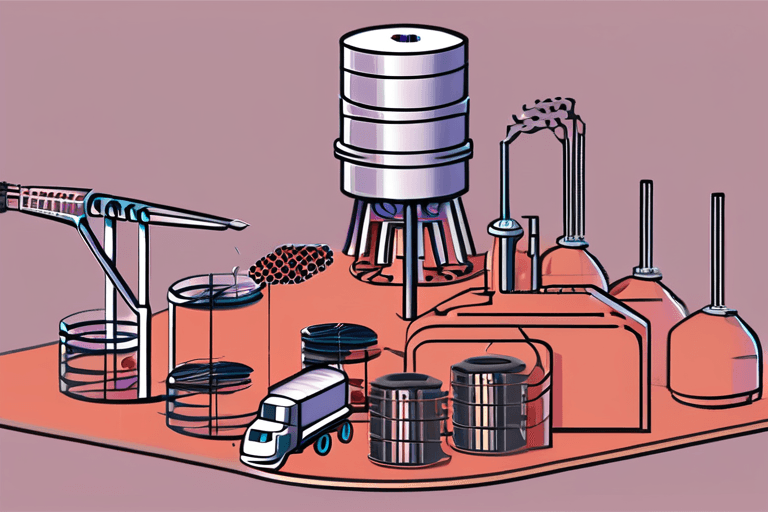
In the sprawling industrial landscape outside Wuxi, China, stands a refinery unlike any other. Here, within its walls, lies the world's sole producer of ultrapure dysprosium, a rare-earth metal now indispensable for the creation of advanced artificial intelligence chips. This seemingly unremarkable facility is a key piece in a much larger, decades-long strategy: China's relentless pursuit to dominate the rare earth elements market, a campaign that began in the dusty plains of Inner Mongolia.
The story begins in April 1964, at an iron ore mine near Baotou, a city nestled 50 miles from the Mongolian border. Chinese geologists stumbled upon a discovery that would reshape the global technological landscape: the world's largest deposit of rare earths. These 17 elements, possessing unique magnetic and conductive properties, were about to become the unsung heroes of the modern age. Deng Xiaoping, then a rising star in the Chinese Communist Party, recognized the significance immediately. "We need to develop steel, and we also need to develop rare earths," he declared during a visit to the remote mine, foreshadowing a national ambition that would unfold over the next six decades.
Rare earth elements are not actually rare in terms of their abundance in the Earth's crust. What makes them strategically important is the difficulty and expense involved in extracting and processing them into usable forms. From smartphones to electric vehicles, wind turbines to missile guidance systems, these elements are the building blocks of countless technologies. Dysprosium, in particular, plays a crucial role in high-strength magnets used in electric motors and, more recently, in the advanced chips powering AI systems. Its ultrapure form, produced exclusively in Wuxi, allows for the creation of more efficient and powerful AI processors, enabling faster data processing and more complex algorithms.
China's dominance in rare earths didn't happen overnight. It was a calculated, long-term strategy involving significant investment in research and development, streamlined environmental regulations (at least initially), and a willingness to accept lower profit margins to undercut international competition. Western companies, facing stricter environmental standards and higher labor costs, gradually ceded ground, allowing China to capture over 80% of the global rare earth production by the early 2000s.
This near-monopoly has profound implications for the future of artificial intelligence. As AI becomes increasingly integrated into every aspect of our lives, from healthcare to finance to national security, the control of key components like dysprosium gives China a significant strategic advantage. Imagine a scenario where access to ultrapure dysprosium is restricted or priced prohibitively high for companies outside China. This could stifle innovation in AI, giving Chinese companies a head start in developing cutting-edge technologies.
"The rare earth situation is a wake-up call," says Dr. Emily Carter, a materials scientist at Princeton University. "We've become overly reliant on a single source for these critical materials. It's not just about economics; it's about national security and technological leadership."
The implications extend beyond just AI. Consider the broader impact on renewable energy. Neodymium, another rare earth element, is essential for the powerful magnets used in wind turbines. A disruption in the supply of neodymium could hinder the global transition to clean energy, impacting efforts to combat climate change.
Recognizing the potential risks, Western governments and companies are now scrambling to diversify their rare earth supply chains. Efforts are underway to reopen mines in the United States, Canada, and Australia, and to develop new processing technologies that are more environmentally friendly. However, catching up with China's decades-long head start will be a formidable challenge.
The future of rare earths is uncertain. Will China maintain its dominance, or will other countries succeed in building competitive industries? The answer will likely depend on a combination of factors, including technological innovation, government policies, and international cooperation. One thing is clear: the race for rare earth supremacy is far from over, and the stakes are higher than ever before. The ultrapure dysprosium being refined in Wuxi is not just a metal; it's a symbol of a global power struggle that will shape the future of technology and the balance of geopolitical power.
















Discussion
Join the conversation
Be the first to comment