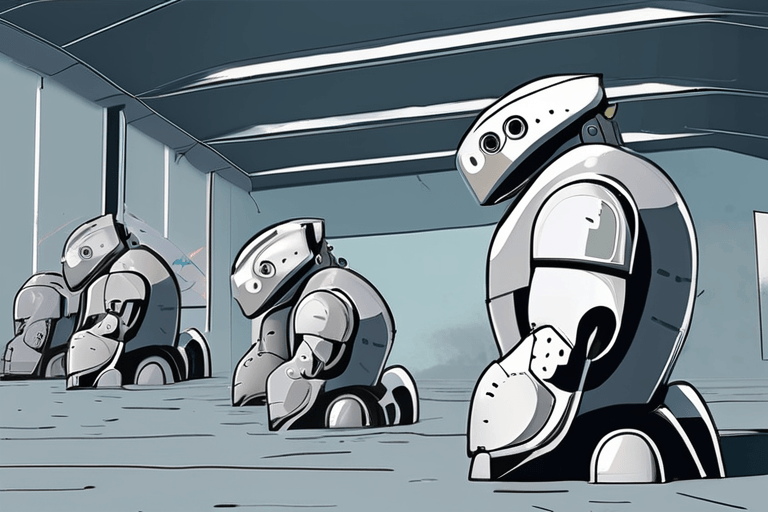
Robots are being utilized in post-cataclysm environments to clear rubble and rebuild infrastructure, showcasing advancements in artificial intelligence and robotics engineering. These robots, designed for resilience and strength, operate using solar energy and sophisticated circulatory systems that recycle environmental elements for joint lubrication, according to engineering reports. One such robot, identified as Twobit, was observed working within the remnants of a building with a deteriorated marble facade.
The robots' deployment highlights the increasing role of AI in disaster recovery and construction. "The use of robots in these scenarios allows for safer and more efficient clearing of debris, especially in unstable environments," said Dr. Anya Sharma, a leading robotics researcher at the Global Institute of Technology. "Their ability to operate autonomously and adapt to changing conditions is crucial."
The circulatory systems employed by robots like Twobit represent a significant advancement in AI-driven maintenance. These systems filter elements from the air and remix them to create lubricants, minimizing the need for external maintenance and extending operational lifespan. However, engineers acknowledge that occasional imbalances in the element mix can occur, requiring intervention.
The building where Twobit was working suffered from climate-related damage prior to the cataclysm, weakening the marble facade. This highlights the interconnectedness of environmental factors and infrastructure integrity. The robots' work not only clears the debris but also provides valuable data for assessing structural vulnerabilities and informing future construction practices.
The use of AI in post-disaster scenarios raises ethical and societal implications. Concerns about job displacement and the potential for over-reliance on automated systems are being actively discussed. "It's important to consider the human element in these transitions," said Mark Olsen, a sociologist studying the impact of AI on labor. "We need to ensure that workers are retrained and equipped with the skills needed to collaborate with these technologies."
Current developments in robotics focus on enhancing sensory perception and decision-making capabilities. Researchers are exploring the use of advanced sensors and machine learning algorithms to enable robots to navigate complex environments and respond to unforeseen challenges. The long-term goal is to create robots that can operate with minimal human supervision, further accelerating the pace of reconstruction and development.



















Discussion
Join the conversation
Be the first to comment