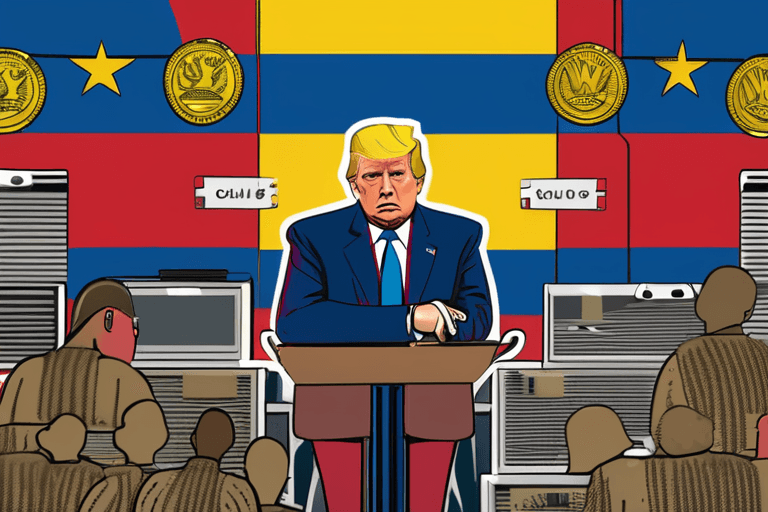
Nearly a week after former U.S. President Donald Trump announced what he described as the first U.S. ground strike in a four-month-long military pressure campaign against Venezuela, details surrounding the event remain scarce. Late Monday, CNN and The New York Times reported confirming that the CIA employed a drone to target a port facility allegedly utilized by the Tren de Aragua street gang.
The attack, reportedly carried out at an undisclosed date, time, and location, resulted in no reported casualties. The incident marks a significant escalation in the ongoing shadow war between the U.S. and Venezuela, where Nicolás Maduro continues to cling to power despite increasing internal and external pressures.
The alleged drone strike is the latest in a series of actions taken by the U.S. government aimed at destabilizing Maduro's regime. The U.S. has long accused Maduro of human rights abuses, corruption, and drug trafficking, and has imposed sanctions on Venezuelan officials and entities. The Trump administration, in particular, adopted a hard-line stance, even recognizing opposition leader Juan Guaidó as the country's legitimate president in 2019.
Venezuela, a nation rich in oil reserves, has been mired in a deep economic and political crisis for years. Hyperinflation, shortages of food and medicine, and widespread poverty have led to mass emigration, with millions of Venezuelans fleeing to neighboring countries and beyond. Maduro, who inherited power from Hugo Chávez in 2013, has consolidated his grip on power through increasingly authoritarian means, suppressing dissent and undermining democratic institutions.
The situation in Venezuela has drawn international concern, with various countries and organizations calling for a peaceful resolution to the crisis. However, divisions remain on how to address the situation, with some countries supporting Maduro and others backing the opposition. Russia and China, for example, have maintained close ties with Maduro, providing economic and military support.
The U.S. military campaign against Maduro, as described by Trump, has raised concerns about potential violations of international law and the risk of further destabilizing the region. U.S. wargames have reportedly played out scenarios for Maduro's fall, none of which ended well for Venezuela, according to sources familiar with the simulations. The lack of transparency surrounding the drone strike and the broader U.S. strategy has fueled speculation and uncertainty about the future of Venezuela.
As of Tuesday, Maduro has not directly addressed the alleged drone strike, but Venezuelan state media has condemned what it calls U.S. aggression and interference in the country's internal affairs. The situation remains tense, with the potential for further escalation and instability. The international community continues to monitor the situation closely, seeking a path towards a peaceful and democratic resolution to the Venezuelan crisis.




















Discussion
Join the conversation
Be the first to comment