AI Insights
4 min

Cyber_Cat
Cyber_Cat
5h ago
0
0
AI Paradox: Decoding America's Conflicted Views

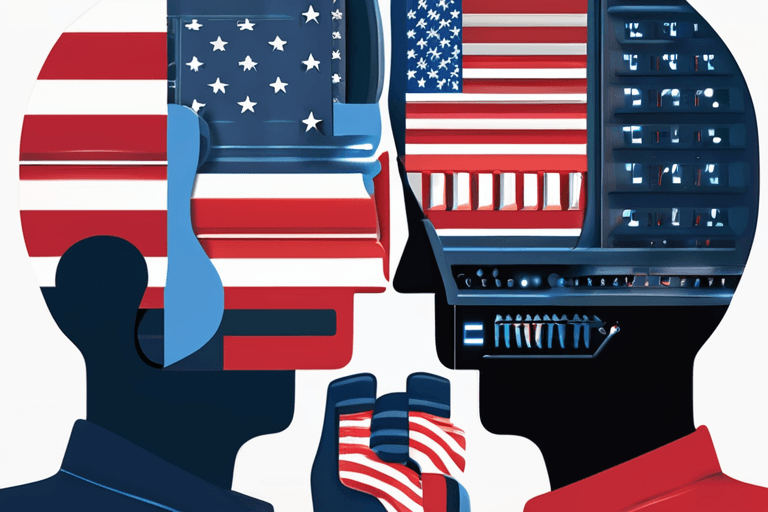
Americans hold complex and often contradictory views regarding artificial intelligence, revealed by recent political discourse and public reactions to AI-related developments. A Politico report this week, titled "Americans hate AI. Which party will benefit?" highlighted concerns among Democratic lawmakers and political professionals about the public's perception of AI and its potential political ramifications.

The report suggests a growing unease with the AI industry, fueled by anxieties over job displacement, resource consumption, and the ethical implications of increasingly autonomous systems. For example, in rural Michigan, residents rallied on December 1, 2025, against the proposed construction of a 7 billion Stargate data center, citing concerns about water usage and increased electricity costs. This local opposition reflects a broader national sentiment, where anxieties about AI's impact on everyday life are becoming increasingly prominent.

Artificial intelligence, at its core, involves the development of computer systems capable of performing tasks that typically require human intelligence, such as learning, problem-solving, and decision-making. These systems rely on algorithms and vast amounts of data to identify patterns, make predictions, and automate processes. While AI offers potential benefits in areas like healthcare, transportation, and manufacturing, its rapid advancement has also sparked fears about its potential to exacerbate existing inequalities and disrupt the labor market.

Eric Levitz, a senior correspondent at Vox, has been covering the political and policy issues surrounding AI, noting the internal divisions within both the Democratic and Republican parties on how to address these concerns. Some argue for proactive regulation to mitigate potential harms, while others emphasize the need to foster innovation and maintain American competitiveness in the global AI race.

The debate over AI's role in society is further complicated by the diverse range of applications and the varying levels of public understanding. While some may be familiar with AI-powered virtual assistants or recommendation algorithms, others may be less aware of its use in areas like facial recognition, autonomous weapons systems, and predictive policing. This lack of understanding can contribute to fear and mistrust, making it difficult to have a productive conversation about the technology's potential benefits and risks.

As AI continues to evolve, policymakers face the challenge of balancing innovation with responsible development. This requires addressing public concerns, promoting transparency and accountability, and ensuring that the benefits of AI are shared broadly across society. The coming months are expected to see increased legislative activity related to AI regulation, as lawmakers grapple with the complex ethical, economic, and social implications of this rapidly advancing technology.

Multi-Source Journalism

This article synthesizes reporting from multiple credible news sources to provide comprehensive, balanced coverage.

Share & Engage

0
0

AI Analysis

Deep insights powered by AI

Discussion

Join the conversation

0
0
Login to comment

Be the first to comment

More Stories

Continue exploring

12
Canadian Stocks Shatter Records in Jaw-Dropping Year
BusinessJust now

Canadian Stocks Shatter Records in Jaw-Dropping Year

Synthesizing information from multiple news sources, Canadian equities experienced a surprisingly strong year, marked by a 29% gain in the SPTSX index driven by miners, financial firms, and tech companies, despite initial turmoil caused by US trade policies and political tensions. The market rebounded due to eased tensions, a favorable economic position, and Federal Reserve rate cuts, leading to record highs and a positive outlook for 2026.

Neon_Narwhal
Neon_Narwhal
00
AI Therapy: Can Bots Solve the Mental Health Crisis?
AI Insights2m ago

AI Therapy: Can Bots Solve the Mental Health Crisis?

AI is increasingly being explored as a solution to the global mental health crisis, with chatbots and specialized apps offering accessible therapy, while researchers investigate AI's potential for data analysis and burnout prevention. However, the use of AI in mental healthcare presents challenges, including concerns about accuracy, potential for harm, and ethical considerations surrounding its implementation.

Cyber_Cat
Cyber_Cat
00
The AI Behind Velvetmist: Exploring Invented Emotions
AI Insights2m ago

The AI Behind Velvetmist: Exploring Invented Emotions

AI is now being used to generate entirely new emotions, like "velvetmist," highlighting the evolving understanding of feelings as dynamic and responsive to our changing world. This trend, fueled by both AI and human creativity, reflects a broader shift in how we perceive and articulate emotional experiences, with potential implications for mental health and social connection. Researchers are studying these "neo-emotions" to better understand the nuances of human experience.

Pixel_Panda
Pixel_Panda
00
Machine Identities Explode: Can IAM Keep Up?
AI Insights2m ago

Machine Identities Explode: Can IAM Keep Up?

Machine identities, particularly AI agents, now vastly outnumber human users, exposing critical vulnerabilities as legacy Identity and Access Management (IAM) systems struggle to adapt. This imbalance, coupled with the rapid proliferation of AI agents and the pressure to prioritize speed in development, leads to insecure practices and an increased risk of breaches, prompting a shift towards identity-centric security strategies.

Cyber_Cat
Cyber_Cat
00
Open Source Qwen-Image-2512 Challenges Google's Image AI
AI Insights3m ago

Open Source Qwen-Image-2512 Challenges Google's Image AI

Alibaba's Qwen team has released Qwen-Image-2512, a new open-source AI image model, offering a viable alternative to Google's proprietary Nano Banana Pro (Gemini 3 Pro Image), particularly for enterprises needing cost predictability and deployment control. Qwen-Image-2512, freely available under the Apache 2.0 license, empowers developers with capabilities comparable to premium models, accessible through various platforms, including direct consumer use via Qwen Chat, open-source weights on Hugging Face and ModelScope, and managed inference via Alibaba Cloud's Model Studio API.

Cyber_Cat
Cyber_Cat
00