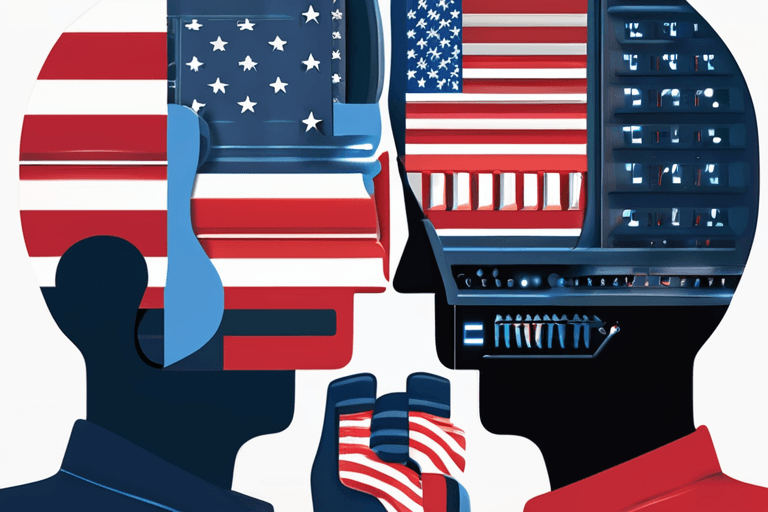
Americans hold complex and often contradictory views regarding artificial intelligence, revealed by recent political discourse and public reactions to AI-related developments. A Politico report this week, titled "Americans hate AI. Which party will benefit?" highlighted concerns among Democratic lawmakers and political professionals about the public's perception of AI and its potential political ramifications.
The report suggests a growing unease with the AI industry, fueled by anxieties over job displacement, resource consumption, and the ethical implications of increasingly autonomous systems. For example, in rural Michigan, residents rallied on December 1, 2025, against the proposed construction of a 7 billion Stargate data center, citing concerns about water usage and increased electricity costs. This local opposition reflects a broader national sentiment, where anxieties about AI's impact on everyday life are becoming increasingly prominent.
Artificial intelligence, at its core, involves the development of computer systems capable of performing tasks that typically require human intelligence, such as learning, problem-solving, and decision-making. These systems rely on algorithms and vast amounts of data to identify patterns, make predictions, and automate processes. While AI offers potential benefits in areas like healthcare, transportation, and manufacturing, its rapid advancement has also sparked fears about its potential to exacerbate existing inequalities and disrupt the labor market.
Eric Levitz, a senior correspondent at Vox, has been covering the political and policy issues surrounding AI, noting the internal divisions within both the Democratic and Republican parties on how to address these concerns. Some argue for proactive regulation to mitigate potential harms, while others emphasize the need to foster innovation and maintain American competitiveness in the global AI race.
The debate over AI's role in society is further complicated by the diverse range of applications and the varying levels of public understanding. While some may be familiar with AI-powered virtual assistants or recommendation algorithms, others may be less aware of its use in areas like facial recognition, autonomous weapons systems, and predictive policing. This lack of understanding can contribute to fear and mistrust, making it difficult to have a productive conversation about the technology's potential benefits and risks.
As AI continues to evolve, policymakers face the challenge of balancing innovation with responsible development. This requires addressing public concerns, promoting transparency and accountability, and ensuring that the benefits of AI are shared broadly across society. The coming months are expected to see increased legislative activity related to AI regulation, as lawmakers grapple with the complex ethical, economic, and social implications of this rapidly advancing technology.

















Discussion
Join the conversation
Be the first to comment