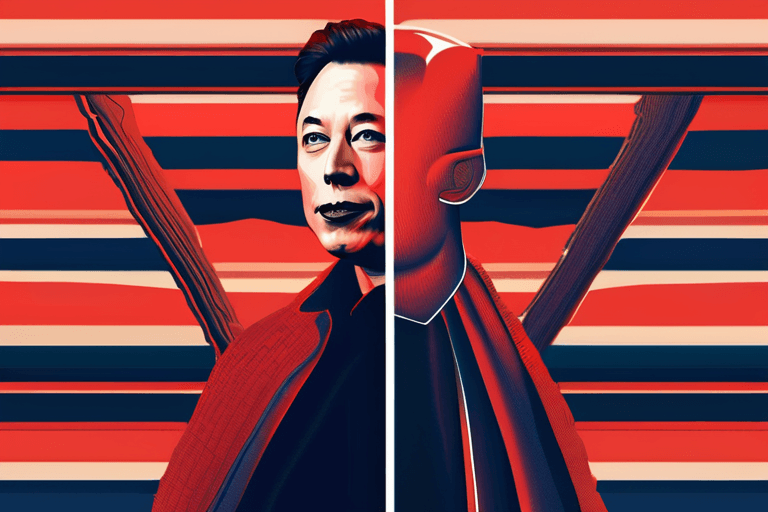
The digital town square, once a battleground perceived as favoring the left, has become a stage for a rightward shift since Elon Musk's acquisition of Twitter, now X, in 2022. This transformation, while celebrated by some, has inadvertently sown seeds of discord within the right itself, creating a complex and evolving political landscape.
The narrative surrounding X's transformation is multifaceted. For many conservatives, Musk's rollback of content moderation policies was a necessary correction, a dismantling of what they saw as biased censorship. The platform, under previous leadership, was often accused of stifling conservative voices, a claim supported by anecdotal evidence and studies highlighting content moderation disparities. Musk's actions, including reinstating previously banned accounts, were hailed as a victory for free speech and a blow against "woke" ideology.
However, this perceived victory has come at a cost. The influx of diverse right-leaning voices, coupled with a more permissive content environment, has amplified existing ideological fault lines. The platform, once a relatively unified front against perceived liberal dominance, is now rife with internal squabbles. Traditional conservatives clash with the alt-right, libertarians spar with social conservatives, and various factions engage in constant debate over the direction of the movement.
"X has become a microcosm of the broader right-wing ecosystem," explains Dr. Eleanor Vance, a political science professor specializing in online political discourse. "The platform's architecture, combined with Musk's policies, has created an environment where these internal tensions are not only visible but actively amplified."
One example of this internal conflict is the ongoing debate surrounding the role of government. While most conservatives agree on the importance of limited government, disagreements arise on specific issues such as trade, immigration, and social policy. These disagreements, once confined to policy papers and academic journals, now play out in real-time on X, often devolving into heated exchanges and personal attacks.
The platform's algorithm, designed to maximize engagement, further exacerbates these divisions. By prioritizing content that elicits strong reactions, X inadvertently creates echo chambers, reinforcing existing biases and limiting exposure to alternative viewpoints. This phenomenon, common across social media platforms, is particularly pronounced on X due to the platform's concentration of right-leaning users.
"The algorithm doesn't care about truth or accuracy," says Mark Olsen, a digital media strategist who has worked with several conservative organizations. "It cares about engagement. And unfortunately, outrage and controversy tend to generate the most engagement."
Musk's own pronouncements and actions on X have further complicated the situation. While he often champions free speech and criticizes "woke" ideology, his interventions have sometimes been perceived as arbitrary and inconsistent, fueling accusations of bias from various factions within the right. His decision to label some news organizations as "state-affiliated media," for example, drew criticism from both the left and the right.
Looking ahead, the future of X and its impact on the right remains uncertain. Some observers believe that the platform will eventually fragment into smaller, more ideologically homogenous communities. Others predict that the internal conflicts will eventually lead to a more nuanced and sophisticated understanding of conservative principles. Regardless of the outcome, it is clear that Elon Musk's acquisition of Twitter has unleashed a powerful force, one that is reshaping the right in ways that are both promising and perilous. The monster he created, if indeed that is what it is, is now out in the open, and its ultimate trajectory remains to be seen.
















Discussion
Join the conversation
Be the first to comment