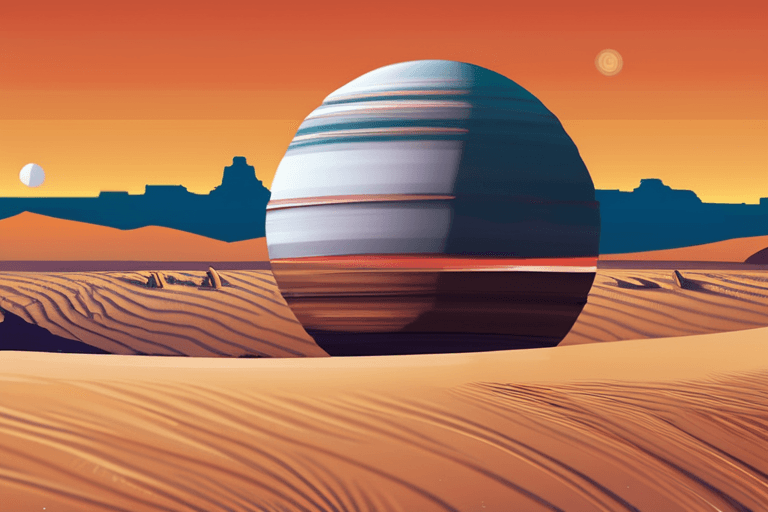
Researchers have identified a Saturn-sized planet located in what is known as the "Einstein desert," a region where planet detection is particularly challenging. The discovery, made using microlensing and data from the Gaia space telescope, offers potential insights into the origins of rogue planets, which drift through interstellar space independent of a host star.
Microlensing, a technique that detects planets by observing how their gravity distorts and magnifies the light of a background star, allowed scientists to spot this distant world. When a planet passes between Earth and a more distant star, it acts as a gravitational lens, causing the star to briefly brighten. Unlike other planet-hunting methods that focus on stars with close-orbiting planets, microlensing can detect planets at much greater distances, even those not bound to a star system.
The "Einstein desert" refers to a region where the probability of detecting planets through microlensing is low due to the specific alignment and distances required for the phenomenon to occur. Finding a planet in this region is particularly significant, suggesting that rogue planets may be more common than previously thought.
Most exoplanets discovered to date orbit relatively close to their host stars, making them easier to track. However, rogue planets present a unique challenge, as they are not gravitationally tied to a star and wander through space. Scientists believe these planets may have been ejected from their original star systems due to gravitational interactions with other planets or stars.
The fortuitous alignment of the Gaia space telescope, which precisely measures the positions and motions of stars, was crucial in confirming the discovery. By combining Gaia's data with microlensing observations, researchers were able to determine the planet's size and location.
The discovery of this Saturn-sized planet in the Einstein desert could reshape our understanding of planet formation and the prevalence of rogue planets in the galaxy. Further research and observations are needed to determine the planet's composition and origin, which could provide valuable clues about the processes that lead to the formation and ejection of planets from star systems.
















Discussion
Join the conversation
Be the first to comment