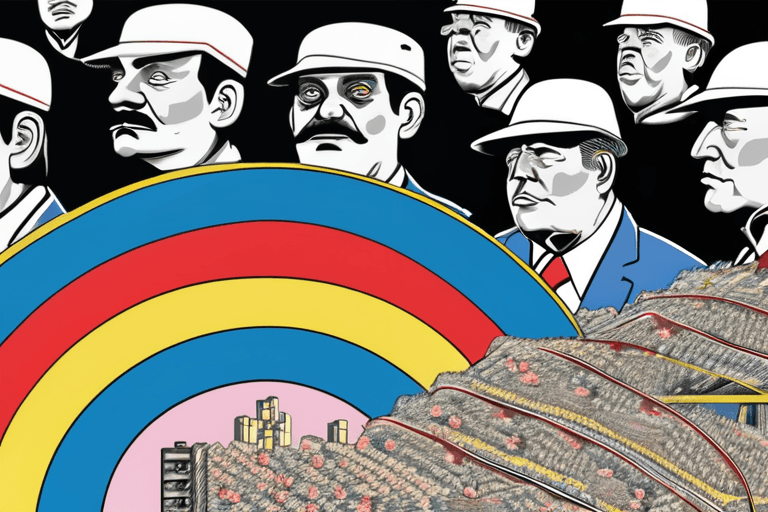
A tense calm settled over Caracas as dawn broke on January 3, 2026. Just hours before, the city had been rocked by explosions, the sky illuminated by flashes of light. The target: Venezuelan President Nicolás Maduro, now in U.S. custody. President Trump, in a televised address, declared the capture a victory for democracy, claiming Maduro was en route to New York to face justice. But how did we get here? What chain of events led to the unprecedented act of a foreign power seizing a sitting head of state?
The roots of this dramatic intervention lie in a complex web of geopolitical tensions and escalating technological capabilities. For years, the U.S. had condemned Maduro's regime, citing human rights abuses, economic mismanagement, and alleged drug trafficking. Sanctions were imposed, diplomatic pressure applied, but Maduro remained defiant. The situation reached a boiling point in late 2025, fueled by a new generation of AI-powered intelligence gathering and military technologies.
The catalyst, according to leaked Pentagon documents, was the deployment of advanced AI-driven surveillance systems. These systems, capable of analyzing vast amounts of data from satellite imagery, social media, and intercepted communications, painted a detailed picture of Maduro's inner circle and their activities. "We were able to identify key vulnerabilities and predict Maduro's movements with unprecedented accuracy," explained Dr. Anya Sharma, a leading AI ethics researcher at Stanford University, in a recent interview. "This level of predictive capability fundamentally altered the calculus of intervention."
The decision to launch a military operation was reportedly driven by a combination of factors. Firstly, the AI analysis suggested a high probability of success with minimal civilian casualties. Secondly, the U.S. intelligence community believed Maduro was on the verge of acquiring advanced weapons technology from a rogue state, posing a direct threat to U.S. national security. Finally, there was the political pressure. With midterm elections looming, the Trump administration needed a decisive victory to bolster its image.
The operation itself was a marvel of technological coordination. AI-powered drones conducted reconnaissance, identifying targets and neutralizing defenses. Autonomous vehicles transported troops and equipment with pinpoint accuracy. And sophisticated cyber weapons disabled Venezuelan communication networks, preventing any coordinated resistance. "It was a surgical strike, designed to minimize collateral damage," claimed a Pentagon spokesperson.
However, the capture of Maduro has sparked widespread condemnation from the international community. Critics argue that it violates international law and sets a dangerous precedent for interventionism. "This is a clear violation of national sovereignty," stated UN Secretary-General Antonio Guterres in a press conference. "It undermines the principles of international cooperation and could lead to further instability."
The long-term implications of this event are profound. It raises fundamental questions about the role of AI in warfare and the future of international relations. As AI technology continues to advance, the temptation to use it for interventionist purposes will only grow stronger. "We need to have a serious conversation about the ethical boundaries of AI in foreign policy," warns Dr. Sharma. "Otherwise, we risk sleepwalking into a world where powerful nations use AI to manipulate and control weaker states."
The capture of Maduro serves as a stark reminder of the transformative power of AI and the urgent need for responsible governance. As technology continues to blur the lines between possibility and reality, humanity must grapple with the ethical dilemmas it presents, ensuring that progress serves the interests of peace and justice, not aggression and domination. The world watches, waiting to see what comes next.

















Discussion
Join the conversation
Be the first to comment