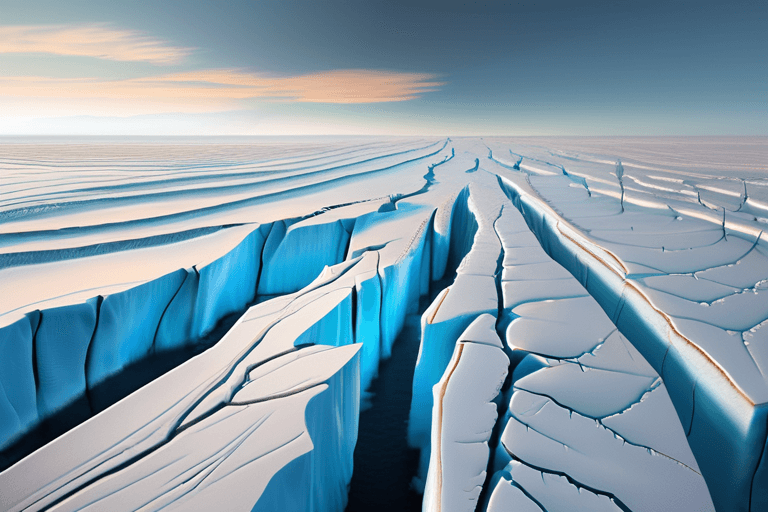
A meltwater lake on Greenland's 79N Glacier, first detected in 1995, has been draining in sudden, dramatic bursts through cracks and vertical ice shafts, according to researchers at the Alfred Wegener Institute, Helmholtz Centre for Polar and Marine Research. These drainage events have accelerated in recent years, creating unusual triangular fracture patterns and flooding the glacier's base with water in a matter of hours.
Scientists observed that the outflowing water is even lifting the glacier in some instances, creating a blister-like effect from below. The formation of the lake itself is a relatively recent phenomenon, as observational records indicate no prior existence of such lakes in this area of the 79N Glacier before 1995.
The rapid drainage is occurring through cracks and vertical shafts known as moulins. As the meltwater rushes through these conduits, it reaches the base of the glacier, lubricating the interface between the ice and the bedrock. This lubrication can accelerate the glacier's flow towards the ocean, contributing to sea-level rise. The triangular fracture patterns observed are a consequence of the immense pressure exerted by the draining water on the surrounding ice.
The implications of this accelerated drainage are significant for understanding the future stability of the 79N Glacier, one of Greenland's largest remaining ice shelves. Researchers are now questioning whether the glacier can ever return to its previous seasonal rhythm of melt and refreezing. The increased frequency and intensity of these drainage events suggest a potential shift towards a new, less stable state.
The Alfred Wegener Institute plans to continue monitoring the 79N Glacier using a combination of satellite imagery, drone surveys, and on-site measurements. Scientists hope to develop more sophisticated models that can predict the future behavior of the glacier and its contribution to sea-level rise. These models may incorporate artificial intelligence (AI) to analyze large datasets and identify patterns that are not readily apparent through traditional methods. AI algorithms can be trained to recognize subtle changes in ice thickness, surface elevation, and meltwater drainage patterns, providing early warnings of potential instability.















Discussion
Join the conversation
Be the first to comment