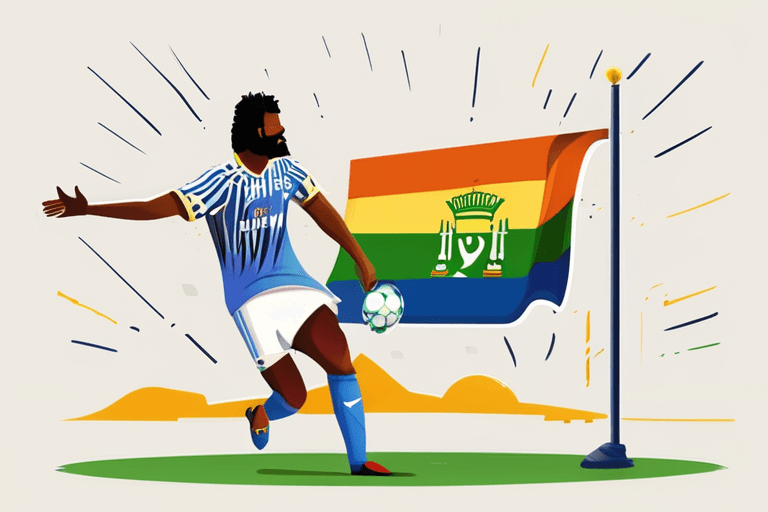
The roar of the crowd in Jeddah is deafening. Not just for the goals, the near misses, or the controversial calls, but for the sheer spectacle of it all. Another El Clasico, this time for the Spanish Super Cup, played out under the desert stars. But this isn't just about football; it's about the evolving landscape of sports, powered by artificial intelligence and transforming how we experience the beautiful game.
Barcelona, the reigning champions, locked horns with a Real Madrid side bolstered by the arrival of Kylian Mbappe. The King Abdullah Sports City Stadium pulsed with anticipation, a testament to the global appeal of these two giants. But beyond the star power on the pitch, AI was working tirelessly behind the scenes, analyzing player performance, predicting tactical shifts, and even enhancing the broadcast for viewers worldwide.
AI's influence on football is no longer a futuristic fantasy; it's a present-day reality. Imagine a system that can analyze thousands of hours of game footage to identify subtle patterns in a player's movement, predicting their next pass with uncanny accuracy. That's the power of machine learning, a subset of AI that allows computers to learn from data without explicit programming. Teams are now using these tools to scout opponents, optimize training regimes, and even make real-time adjustments during matches.
"We're seeing a revolution in how football is played and understood," says Dr. Anya Sharma, a sports analytics expert at the University of Madrid. "AI is providing insights that were simply impossible to obtain before. It's like having a super-powered scout and strategist all rolled into one."
The implications extend beyond the pitch. AI is also transforming the fan experience. Personalized content recommendations, interactive broadcasts, and even AI-powered commentators are becoming increasingly common. Imagine a world where you can choose to view a game through the eyes of your favorite player, or receive real-time analysis tailored to your specific interests.
However, this technological revolution also raises important questions. Will AI lead to a homogenization of playing styles, as teams adopt strategies based on data-driven insights? Will it exacerbate the gap between wealthy clubs with access to advanced AI tools and smaller teams struggling to compete? And what about the ethical considerations of using AI to predict player performance and potentially influence transfer decisions?
"We need to ensure that AI is used responsibly and ethically in football," warns Javier Rodriguez, a former La Liga referee. "It's a powerful tool, but it shouldn't replace human judgment or undermine the integrity of the game."
As the final whistle blew in Jeddah, regardless of which team emerged victorious, one thing was clear: AI is here to stay. It's reshaping the game we love, offering new possibilities and posing new challenges. The future of football is not just about goals and glory; it's about the intelligent application of technology to enhance the sport for players, coaches, and fans alike. The Spanish Super Cup in Saudi Arabia was just another chapter in this ongoing evolution, a glimpse into a future where AI and human skill combine to create a truly unforgettable spectacle.
















Discussion
Join the conversation
Be the first to comment