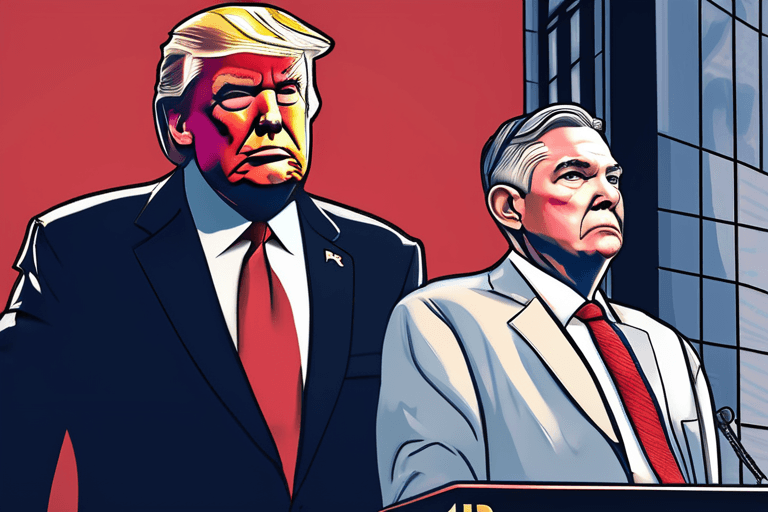
The marble halls of the Federal Reserve, usually echoing with the hushed tones of economic debate, are now reverberating with the clang of legal action. A criminal investigation, launched by the Trump administration into Fed Chair Jerome Powell, has sent shockwaves through the financial world, raising critical questions about the sanctity of central bank independence and the potential weaponization of political power.
The investigation centers on Powell's testimony before Congress regarding a $2.5 billion renovation of the Fed's Washington, D.C. headquarters. While the stated focus is on potential irregularities in the renovation project, Powell himself has publicly suggested that these concerns are merely a pretext. He believes the true aim is to undermine the Fed's autonomy in setting interest rates, a cornerstone of economic stability. This unprecedented move raises the specter of political interference in monetary policy, a development that could have far-reaching consequences for the U.S. and global economies.
The independence of central banks is a principle fiercely guarded by economists and policymakers alike. It rests on the idea that monetary policy decisions, such as setting interest rates and managing inflation, should be insulated from short-term political pressures. This allows central bankers to make decisions based on long-term economic considerations, rather than being swayed by the electoral cycle or the whims of politicians. The Fed, in particular, has historically enjoyed a high degree of autonomy, a tradition that is now being challenged in a dramatic and public way.
"The threat of criminal charges is a serious escalation," says Dr. Anya Sharma, a professor of economics at the University of Chicago. "It sends a chilling message to anyone who might consider disagreeing with the administration's economic policies. If the Fed is perceived as being under the thumb of the White House, it could erode confidence in the dollar and destabilize financial markets."
The investigation also raises questions about the role of artificial intelligence in analyzing complex financial data and identifying potential wrongdoing. AI algorithms are increasingly being used by regulatory agencies to detect fraud and other financial crimes. However, the use of AI in such investigations also raises concerns about bias and transparency. If the algorithms are not properly designed and monitored, they could lead to unfair or inaccurate conclusions.
"AI can be a powerful tool for uncovering financial irregularities," explains David Chen, a data scientist specializing in financial crime detection. "But it's crucial to remember that AI is only as good as the data it's trained on. If the data is biased, the AI will be biased as well. And we need to be very careful about ensuring that AI is used in a way that respects due process and protects individual rights."
The implications of this investigation extend beyond the immediate legal battle. It could set a dangerous precedent for future administrations, potentially leading to a politicization of monetary policy that could have devastating consequences for the economy. The future of the Fed's independence, and indeed the stability of the U.S. financial system, hangs in the balance. As the investigation unfolds, the world will be watching closely, hoping that the principles of sound economic policy and the rule of law will prevail.















Discussion
Join the conversation
Be the first to comment