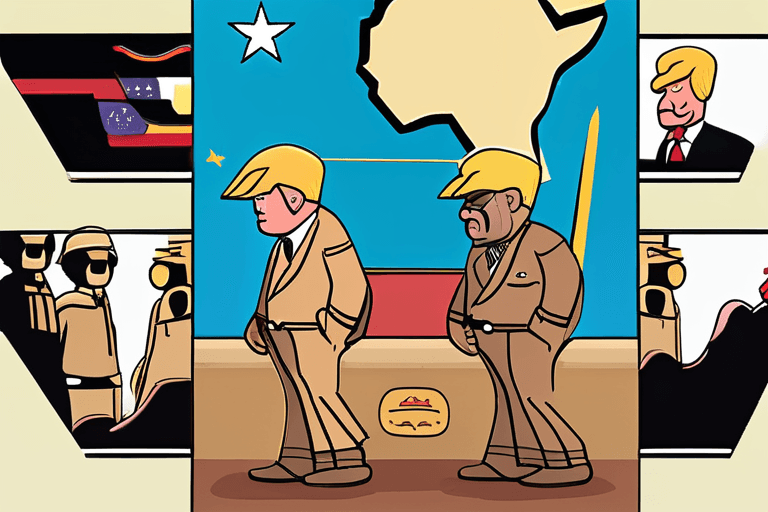
President Donald Trump has invoked historical foreign policy doctrines to justify recent actions, including the capture of Venezuelan President Nicolás Maduro, attempts to acquire Greenland, and threats against Iran. Trump stated at a recent news conference that the capture of Maduro was due to actions that constituted a "gross violation of the core principles of American foreign policy dating back more than two centuries to the Monroe Doctrine."
The Monroe Doctrine, articulated in 1823 by President James Monroe, warned European powers against further colonization or intervention in the Americas. Trump has claimed to have expanded upon this doctrine, referring to it as the "'Donroe Doctrine.'"
These actions and justifications draw parallels to President Theodore Roosevelt's "big stick" diplomacy, a policy that prioritized diplomatic solutions but also emphasized the potential use of military force to achieve foreign policy objectives. Roosevelt's approach, often referred to as "speak softly and carry a big stick," saw the U.S. exert its influence in Latin America and the Caribbean.
Critics argue that Trump's approach represents an aggressive and unilateralist foreign policy, while supporters maintain that it is a necessary assertion of American interests. The implications of these policies are still unfolding, with ongoing diplomatic and political ramifications.

















Discussion
Join the conversation
Be the first to comment