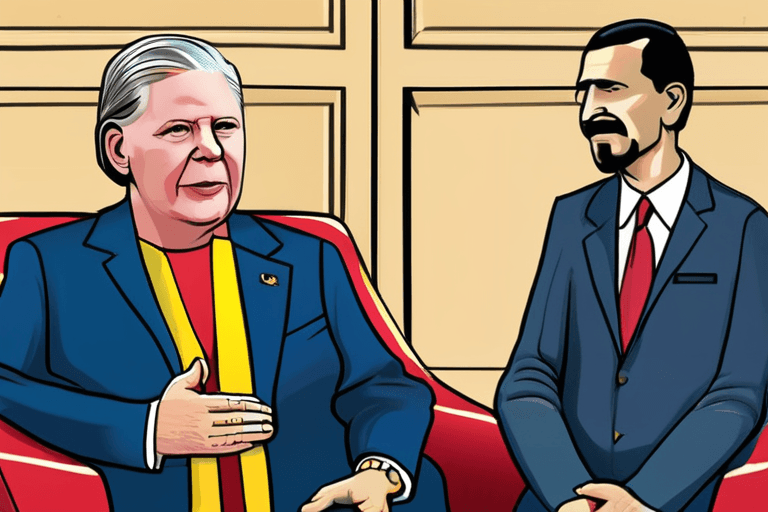
CIA Director John Ratcliffe met with Venezuela's Interim President Delcy Rodríguez in Caracas on Thursday for two hours, according to a U.S. official. The meeting, which occurred "at President Trump's direction," aimed to establish trust and communication after the U.S. seizure of former President Nicolás Maduro nearly two weeks prior, the official stated.
Ratcliffe and Rodríguez discussed potential economic collaboration and the need to prevent Venezuela from serving as a safe haven for U.S. adversaries, the official added. The meeting coincided with Rodríguez's first state of the union address as interim president, during which she announced oil industry reforms designed to attract greater foreign investment, a departure from Maduro's previous policies.
During her address, Rodríguez stated her willingness to engage with the U.S. "diplomatically through political dialogue," while emphasizing Venezuela's commitment to defending its "dignity and honour." President Trump has indicated that U.S. oil companies will move into Venezuela, generating revenue for both the Venezuelan people and the United States, according to a top official.
The use of artificial intelligence (AI) in analyzing diplomatic interactions and predicting potential outcomes is becoming increasingly prevalent. AI algorithms can process vast amounts of data, including transcripts, news reports, and social media activity, to identify patterns and sentiments that might be missed by human analysts. This technology can assist policymakers in understanding the nuances of international relations and formulating more effective strategies. However, the reliance on AI in diplomacy also raises concerns about bias in algorithms and the potential for misinterpretation of complex geopolitical situations.
The recent developments in Venezuela highlight the complex interplay between political instability, economic interests, and international relations. The U.S. seizure of Maduro and the subsequent meeting between Ratcliffe and Rodríguez signal a potential shift in U.S. policy towards Venezuela. Rodríguez's willingness to engage in dialogue with the U.S. and her proposed oil industry reforms could pave the way for increased foreign investment and economic recovery.
The situation remains fluid, and future developments will likely depend on the outcome of ongoing negotiations between the U.S. and Venezuela, as well as the response of other international actors. The role of AI in monitoring and analyzing these developments will continue to grow, providing policymakers with valuable insights and potentially shaping the future of U.S.-Venezuela relations.














Discussion
Join the conversation
Be the first to comment