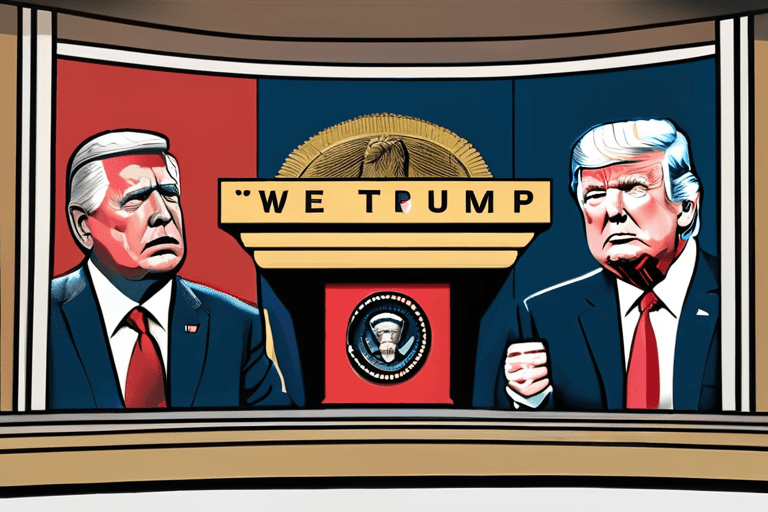
The air crackled with tension. A routine interview request had morphed into a high-stakes standoff. CBS News, eager to capture President Donald Trump's perspective on his early days back in office for "CBS Evening News," found itself facing an unexpected ultimatum: air the interview in its entirety, unedited, or face a lawsuit. The threat, delivered by White House Press Secretary Karoline Leavitt, underscored the increasingly fraught relationship between the Trump administration and the media, raising questions about transparency, control, and the very nature of news dissemination in the age of AI-driven content manipulation.
The incident, first reported by The New York Times, highlights a growing concern: the potential for AI to be weaponized in the battle for public opinion. While the Trump administration's demand for an unedited broadcast might seem like a call for transparency, it also reveals a strategic understanding of how even raw, unedited footage can be selectively amplified and manipulated through AI-powered tools to shape narratives.
The interview in question, conducted by "CBS Evening News" anchor Tony Dokoupil, was intended to provide viewers with insights into President Trump's renewed agenda. However, the White House's insistence on an unedited broadcast suggests a desire to bypass traditional journalistic gatekeeping. "He said, 'Make sure you don't cut the tape, make sure the interview is out in full,'" Leavitt reportedly told Dokoupil and his executive producer, Kim Harvey. "He said, 'If it's not out in full, we'll sue your ass off.'"
This demand arrives at a time when AI is rapidly transforming the media landscape. Deepfakes, AI-generated audio, and sophisticated editing tools make it easier than ever to distort reality. While CBS News likely intended to present a fair and balanced report, the White House's preemptive threat reveals a deep distrust of traditional media outlets and a preference for controlling the narrative directly.
"The ability to manipulate audio and video with AI is becoming increasingly sophisticated," explains Dr. Anya Sharma, a professor of media studies at Stanford University. "This creates a situation where even seemingly authentic content can be subtly altered to promote a specific agenda. The demand for an unedited broadcast, while appearing transparent, could be a calculated move to release content that can then be further manipulated and amplified through AI-driven channels."
The implications of this incident extend beyond a single interview. It underscores the urgent need for media literacy and critical thinking skills in the face of increasingly sophisticated AI-driven disinformation campaigns. As AI tools become more accessible, the ability to discern fact from fiction will become even more crucial.
Furthermore, the threat of legal action raises questions about the future of journalism. If news organizations are constantly threatened with lawsuits for exercising editorial judgment, it could lead to a chilling effect on investigative reporting and critical analysis. The Trump administration's previous $16 million settlement with CBS News parent company, Paramount, over a "60 Minutes" interview serves as a stark reminder of the potential financial consequences of challenging the powerful.
Looking ahead, the media industry must adapt to the challenges posed by AI. This includes developing AI-powered tools to detect deepfakes and other forms of manipulated content, as well as investing in media literacy programs to educate the public about the dangers of disinformation. The battle for truth in the age of AI will require a multi-faceted approach, combining technological innovation with a renewed commitment to journalistic ethics and public education. The CBS News incident serves as a wake-up call, reminding us that the future of news depends on our ability to navigate the complex and ever-evolving landscape of AI-driven media.
















Discussion
Join the conversation
Be the first to comment