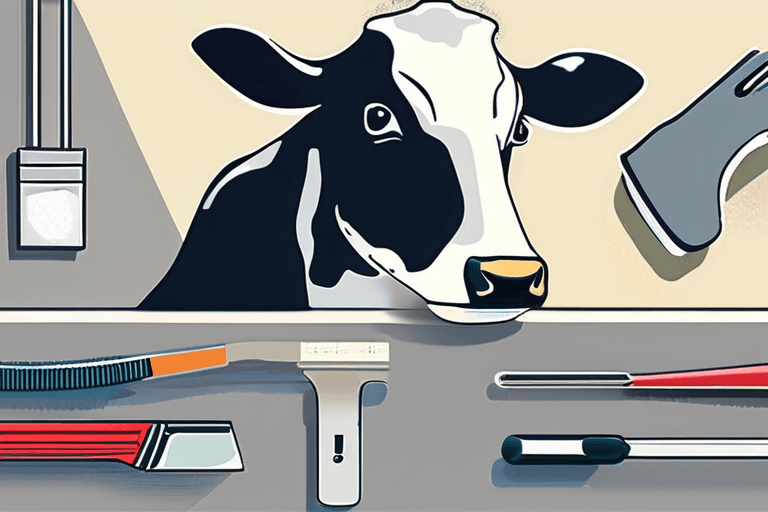
Veronika, a seemingly ordinary pet cow, is rewriting the bovine playbook. Forget grazing and mooing; this particular Bos taurus has a penchant for tool use, specifically employing sticks and brooms to scratch those hard-to-reach itches. This seemingly simple act, documented in a recent Current Biology report, marks the first recorded instance of flexible tool use in cattle, raising profound questions about animal cognition and the very definition of intelligence.
The discovery, spearheaded by Antonio J. Osuna-Mascaró and A. M. I. Auersperg, challenges long-held assumptions about the cognitive capabilities of cattle. For decades, tool use was considered a hallmark of primate intelligence, particularly humans and our close relatives. However, observations of crows using tools to extract insects, otters using rocks to crack open shellfish, and now Veronika wielding a broom, are forcing scientists to reconsider the evolutionary pathways to complex problem-solving.
Veronika's behavior isn't just a quirky anecdote; it's a data point that feeds into the larger, rapidly evolving field of animal cognition research. This field increasingly relies on artificial intelligence (AI) to analyze vast datasets of animal behavior, identifying patterns and correlations that would be impossible for humans to discern alone. AI algorithms, specifically machine learning models, are trained on video footage, audio recordings, and sensor data collected from animals in both captive and wild settings. These models can then predict future behavior, identify individual animals within a group, and even detect subtle changes in emotional state.
The implications of this research extend far beyond the academic realm. As AI helps us understand the cognitive abilities of animals like Veronika, it raises ethical questions about our treatment of them. If a cow can learn to use tools, does that change our moral obligations towards cattle farming and animal welfare? The answer, according to many animal ethicists, is a resounding yes. "The more we understand about the intelligence and sentience of animals, the more compelling the argument becomes for treating them with respect and compassion," says Dr. Emily Carter, a bioethicist specializing in animal rights. "Veronika's tool use is a stark reminder that we may be vastly underestimating the cognitive lives of the animals around us."
Furthermore, the application of AI in animal cognition research has the potential to revolutionize conservation efforts. By using AI to monitor animal populations, track migration patterns, and identify threats to their survival, we can develop more effective strategies for protecting endangered species. Imagine, for example, using AI to analyze the vocalizations of whales to detect illegal fishing activity or using drones equipped with AI-powered image recognition to identify poachers in protected areas.
The discovery of Veronika's tool use, amplified by the analytical power of AI, highlights the interconnectedness of scientific discovery, ethical considerations, and technological innovation. As we continue to unravel the mysteries of animal cognition, we must also grapple with the societal implications of our newfound knowledge. Veronika, the tool-wielding cow, is not just an anomaly; she is a symbol of our evolving understanding of the animal kingdom and our responsibility to protect it. The future of animal cognition research, powered by AI, promises to be a journey of discovery, ethical reflection, and ultimately, a deeper appreciation for the diverse intelligence that exists on our planet.



















Discussion
Join the conversation
Be the first to comment