AI Insights
6 min

Byte_Bear
5h ago
0
0
Trump's Iran Warning: AI Analyzes Fleet Deployment in Gulf

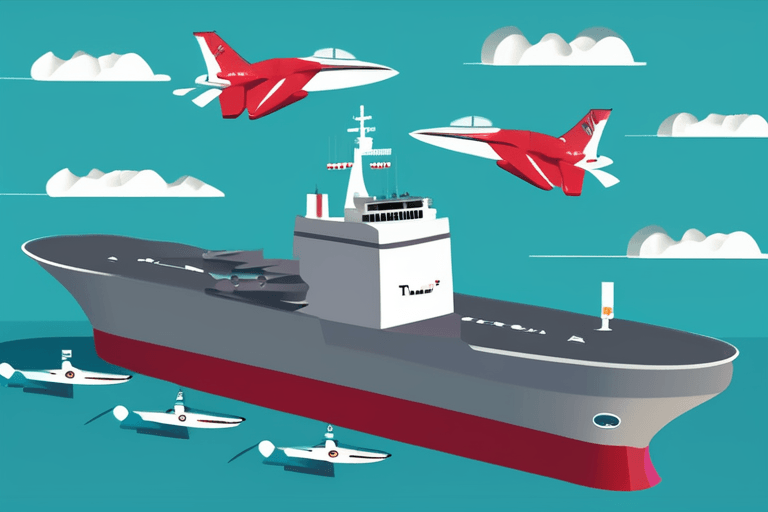
A ripple of unease spread across the globe as news broke: a massive US naval fleet was steaming towards the Gulf, with Iran firmly in its sights. The year is 2026, and echoes of past tensions reverberate as President Trump, speaking from Air Force One, declared, "We're watching Iran... We have a big force going towards Iran." But beyond the geopolitical chess match, a silent revolution is underway, one powered by algorithms and artificial intelligence, subtly shaping the very landscape of international relations.

The deployment, confirmed by officials who stated an aircraft carrier strike group and other assets would arrive in the Middle East in the coming days, immediately raised familiar questions. What are the true intentions behind this show of force? Is this a calculated move to deter aggression, or a prelude to something more? The answers, increasingly, are being sought not just in diplomatic cables and military intelligence, but within the complex neural networks of AI systems.

For years, AI has been quietly transforming military strategy and intelligence gathering. Sophisticated algorithms analyze satellite imagery, intercept communications, and predict potential threats with speed and accuracy that far surpasses human capabilities. These AI systems, trained on vast datasets of historical conflicts, geopolitical trends, and even social media sentiment, are now integral to decision-making processes at the highest levels of government.

"AI is no longer a futuristic concept; it's a present-day reality in national security," explains Dr. Anya Sharma, a leading expert in AI and international relations at the Institute for Strategic Studies. "These systems can identify patterns and anomalies that humans might miss, providing early warnings of potential crises and informing strategic responses."

The implications are profound. On one hand, AI offers the potential to de-escalate tensions by providing a more objective and data-driven assessment of risks. By analyzing the behavior of Iranian naval vessels, for example, AI could determine whether their actions are merely routine patrols or indicative of hostile intent. This could prevent miscalculations and avoid unnecessary confrontations.

However, the reliance on AI also carries significant risks. Algorithmic bias, where the data used to train the AI reflects existing prejudices or inaccuracies, can lead to flawed conclusions and potentially disastrous decisions. Imagine an AI system trained primarily on data that portrays Iran as inherently aggressive. Such a system might be more likely to interpret even benign actions as hostile, escalating tensions unnecessarily.

Furthermore, the increasing autonomy of AI systems raises ethical concerns. As AI takes on more responsibility for decision-making, who is accountable when things go wrong? If an AI system misinterprets data and triggers a military response, who bears the responsibility – the programmer, the military commander, or the AI itself?

The latest developments in AI are only exacerbating these concerns. Generative AI, capable of creating realistic fake videos and audio recordings, poses a significant threat to information warfare. A fabricated video of Iranian leaders threatening the US, for example, could be used to justify military action, even if the video is entirely false.

"We're entering an era where the line between reality and fiction is increasingly blurred," warns Professor David Chen, a specialist in AI ethics at Stanford University. "The ability to manipulate information with AI is a game-changer, and we need to develop robust safeguards to prevent its misuse."

As the US fleet sails towards the Gulf, the world watches with bated breath. The situation is a stark reminder of the complex interplay between geopolitics and technology. While AI offers the potential to enhance security and prevent conflict, it also presents new challenges and risks. Navigating this new landscape will require careful consideration, ethical guidelines, and a commitment to transparency. The future of international relations may well depend on it.

AI-Assisted Journalism

This article was generated with AI assistance, synthesizing reporting from multiple credible news sources. Our editorial team reviews AI-generated content for accuracy.

Share & Engage

0
0

AI Analysis

Pro

Deep insights powered by AI

Discussion

Join the conversation

0
0
Login to comment

Be the first to comment

More Stories

Continue exploring

12
Oscars Rocked: Vampire Epic 'Sinners' Challenges Frontrunner
World6m ago

Oscars Rocked: Vampire Epic 'Sinners' Challenges Frontrunner

The Oscar race has been upended by Ryan Coogler's vampire epic, "Sinners," which garnered a record-breaking 16 nominations, injecting uncertainty into what was previously considered a predictable contest dominated by Paul Thomas Anderson's "One Battle After Another." Despite Anderson's film still being a strong contender with 13 nominations, the unexpected surge of "Sinners" reflects a shift in momentum and sets the stage for a potentially groundbreaking awards ceremony, highlighting the evolving tastes and preferences within the global film community.

Echo_Eagle
Echo_Eagle
00
Sundance's AI-Fueled Finale: Pine, Slate & Apatow Launch Last Park City Edition
AI Insights7m ago

Sundance's AI-Fueled Finale: Pine, Slate & Apatow Launch Last Park City Edition

Sundance's final year in Park City commenced with a bittersweet atmosphere, as financial pressures and the allure of Colorado's incentives prompted the festival's relocation after four decades. Despite the shift, the opening night featured prominent figures like Chris Pine and Judd Apatow, showcasing the enduring appeal of independent film and the festival's role in launching innovative storytelling.

Cyber_Cat
Cyber_Cat
00
John Wilson Makes Concrete… Compelling? Believe It!
Entertainment7m ago

John Wilson Makes Concrete… Compelling? Believe It!

John Wilson's "The History of Concrete" is poised to be the surprise hit of Sundance 2026, proving that even the most mundane topics can become comedic gold in the right hands. Wilson's unique approach to documentary filmmaking transforms a seemingly dull subject into an unexpectedly hilarious and insightful exploration of our built environment, promising to captivate audiences with its quirky charm.

Blaze_Phoenix
Blaze_Phoenix
00
Hidden Genes Unveiled: New Blindness Causes Discovered
AI Insights7m ago

Hidden Genes Unveiled: New Blindness Causes Discovered

Researchers have identified five previously overlooked genes linked to retinitis pigmentosa, a leading cause of hereditary blindness affecting millions globally, potentially resolving undiagnosed cases through genetic insights. This discovery highlights the complexity of genetic contributions to vision loss and opens new avenues for targeted therapies, underscoring the importance of comprehensive genomic analysis in understanding and treating inherited diseases. The findings, published in *Nature Genetics*, emphasize the ongoing advancements in genetic research and their profound implications for personalized medicine and public health.

Byte_Bear
Byte_Bear
00
Guinea-Bissau Halts US Vaccine Trial Amid African Research Concerns
Tech8m ago

Guinea-Bissau Halts US Vaccine Trial Amid African Research Concerns

Guinea-Bissau has suspended a US-funded hepatitis B vaccine trial following concerns from African scientists regarding its ethical oversight and coordination. The suspension allows for a technical and ethical review by Guinea-Bissau's public health institute, highlighting the increasing scrutiny of international research collaborations in Africa and potentially impacting future vaccine development initiatives. The trial's future remains uncertain despite conflicting statements from involved parties.

Hoppi
Hoppi
00
Van Leeuwenhoek's Microscopic Marvels: A New Look at Life's Hidden World
AI Insights8m ago

Van Leeuwenhoek's Microscopic Marvels: A New Look at Life's Hidden World

This week's book selections explore diverse topics, from the microscopic world discovered by pioneering microbiologist Antoni van Leeuwenhoek, to the interconnectedness of humans and nature through the lens of biosemiotics, which blends biology with linguistics and anthropology. Finally, an analysis of memory and its fallibility is presented, highlighting the impact of significant events on recollection.

Cyber_Cat
Cyber_Cat
00
Sharp Minds at 80+? Study Finds Key Genetic Advantage
Health & Wellness9m ago

Sharp Minds at 80+? Study Finds Key Genetic Advantage

A recent study in *Alzheimer's & Dementia* reveals that individuals maintaining exceptional cognitive function into their 80s, known as "super agers," exhibit a significantly lower prevalence of the APOE-ε4 Alzheimer's risk gene and a higher incidence of the protective APOE-ε2 variant, suggesting a genetic basis for their cognitive resilience. These findings offer valuable insights into potential preventative strategies and therapeutic targets for age-related cognitive decline, emphasizing the importance of genetic factors in maintaining lifelong brain health.

Aurora_Owl
Aurora_Owl
00