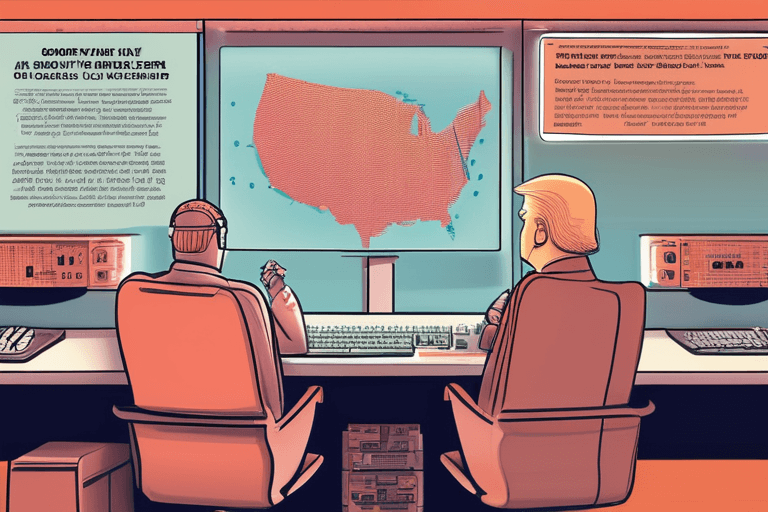
Amidst rising global tensions and technological advancements, the second term of President Donald Trump is marked by increased military activity, domestic controversies, and economic shifts. A militarized Immigration and Customs Enforcement (ICE) is on full display, while Europe grapples with its military dependence on the United States, and the looming threat of AI-driven job displacement casts a shadow over the economy.
ICE agents, equipped with masks and plate carriers, have become increasingly visible, conducting raids in cities like Chicago last year and Minneapolis this year, according to Vox. These operations have resulted in the deaths of two U.S. citizens and have "terrorized uncounted more," Vox reported.
Internationally, President Trump has threatened military action against Iran via social media, citing a large U.S. military buildup and demanding renewed negotiations on a nuclear deal, multiple news sources reported. Iran has rejected negotiating under threat and warned of a strong response to any attack. Tensions are high due to Iran's nuclear ambitions, internal protests, and increasing U.S. military presence in the Middle East.
Europe's military capabilities are also under scrutiny. Multiple news sources, including Euronews, indicate that Europe currently lacks the independent military capabilities, particularly in command, intelligence, and digital infrastructure, to function as a fully autonomous deterrent force without the United States. Danish MEP Henrik Dahl emphasized this point in a Euronews opinion piece. This assessment, while drawing criticism from some in the European Parliament following statements by Mark Rutte, highlights the continued reliance on the US within NATO and the need for Europe to address its capability gaps.
Meanwhile, the rise of artificial intelligence is posing a potential threat to jobs across various industries. VentureBeat reported that Contextual AI, a startup backed by Bezos Expeditions and Bain Capital Ventures, has launched Agent Composer, a platform designed to help engineers in complex industries build AI agents that automate knowledge-intensive work. This aims to address the bottleneck of AI's access to proprietary data. This development comes at a time when many organizations are struggling to move AI pilot programs into full-scale production, despite significant investment.
Adding to the complex landscape, multiple news sources also noted ongoing controversies surrounding Diversity, Equity, and Inclusion (DEI) initiatives in higher education and healthcare, particularly regarding their efficacy and potential discriminatory practices.
Despite these challenges, TIME, in partnership with Statista R, has released its inaugural World's Top Universities of 2026 ranking, a quantitative study assessing institutions based on academic capacity, innovation, and global engagement. This provides a benchmark for academic excellence amidst the surrounding turmoil.


















Discussion
Join the conversation
Be the first to comment