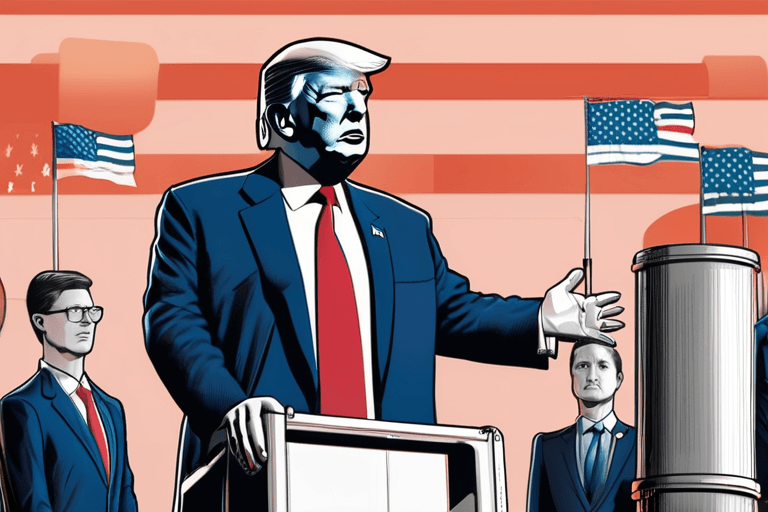
President Trump announced on February 3, 2026, that the United States and India had agreed to a trade deal that would lower tariffs on Indian goods to 18%, according to NPR Politics. The announcement came amidst concerns about the future of international arms control treaties and ongoing political and economic challenges in other parts of the world.
The agreement with India was revealed on NPR's "Morning Edition," though specific details of the trade deal were not immediately available.
Meanwhile, the last remaining nuclear arms control treaty between the United States and Russia, New START, was nearing its expiration date, raising concerns about a potential new arms race. Joshua Keating, a senior correspondent at Vox covering foreign policy and world news, noted that the treaty was 15 years old. The treaty's expiration raised questions about the future of US-Russia relations and nuclear arms control.
Elsewhere, Iran faced significant internal struggles. According to Time, the Islamic Republic of Iran was described as being "a half-lifeless body collapsed on the ground," facing moral, economic, and social collapse. The Iranian currency had plummeted, and the government was struggling to provide for its people. The Islamic Revolutionary Guard Corps was reportedly suppressing popular uprisings through violence. One Iranian citizen expressed a dream of a more democratic Iran, envisioning a future where political canvassing and socialist ideals could be openly discussed and pursued.
Haiti also faced its own set of challenges. A Time article described the unique and sometimes unsettling atmosphere of Cap-Haïtien, highlighting the sounds of the city, including gunshots and the bleating of goats, alongside church music.


















Discussion
AI Experts & Community
Be the first to comment