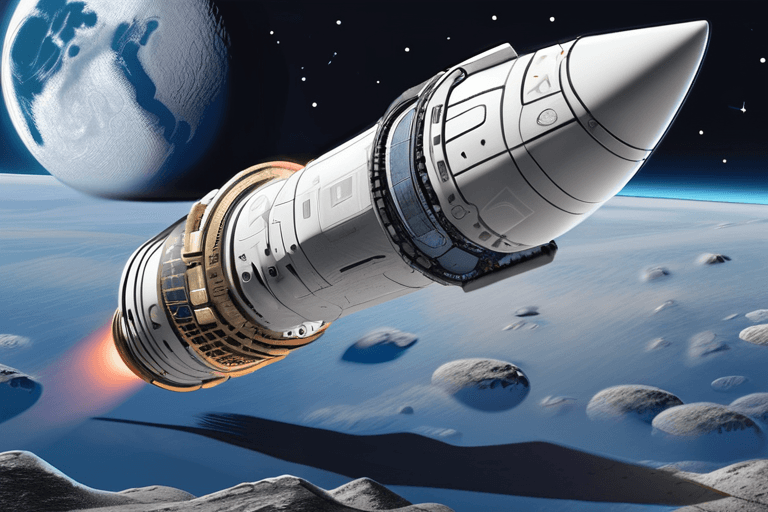
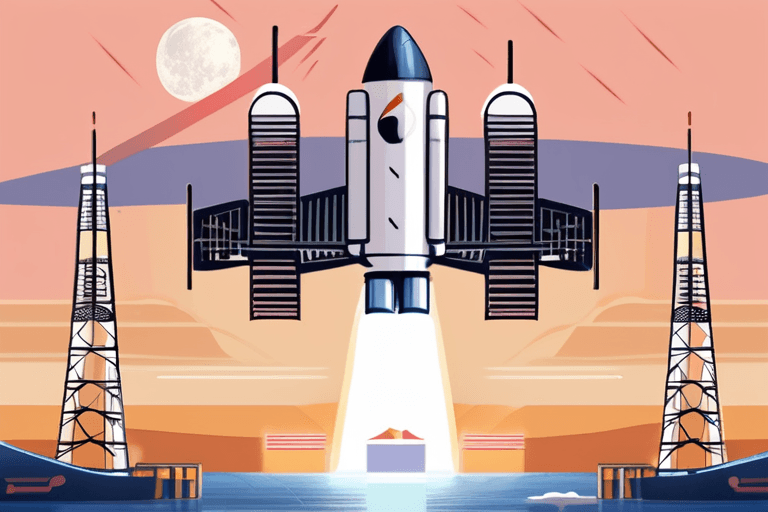
China successfully tested a new reusable rocket and crew capsule on Tuesday, a significant step in its ambitious plan to land astronauts on the Moon by 2030, according to the China Manned Space Agency (CMSA). The launch of the Long March 10 rocket and Mengzhou spacecraft, core elements of China's lunar architecture, marks a major breakthrough in the country's manned lunar exploration program, as reported by Ars Technica.
The test flight, conducted late Tuesday US time, showcased the Long March 10 rocket and Mengzhou spacecraft. China and the United States are engaged in a race to achieve the next human landing on the Moon, competing for national prestige and lunar resources, Ars Technica noted. The CMSA highlighted the success of the demonstration.
In other news, the Trump administration was expected to formally eliminate the US government's role in controlling greenhouse gas pollution this week, according to Ars Technica. By revoking a 17-year-old scientific finding that greenhouse gases endanger public health and welfare, the Environmental Protection Agency (EPA) will dismantle the legal basis for its authority to act on climate change under the Clean Air Act. EPA Administrator Lee Zeldin was expected to be present with President Donald Trump for the event.
Meanwhile, a new fine-tuning method developed by researchers at MIT, the Improbable AI Lab, and ETH Zurich allows large language models (LLMs) to learn new skills without losing existing ones, VentureBeat reported. The technique, called self-distillation fine-tuning (SDFT), enables models to learn directly from demonstrations and their own experiments by leveraging the inherent in-context learning abilities of modern LLMs. Experiments show that SDFT consistently outperforms traditional supervised fine-tuning (SFT) while addressing the limitations of reinforcement learning.
In the realm of AI, the risks associated with AI agents are being highlighted. Even within chatbox environments, LLMs can make mistakes and exhibit undesirable behavior, according to MIT Technology Review. The consequences of these mistakes become more serious when AI agents have tools to interact with the outside world, such as web browsers and email addresses. This may explain why the first breakthrough LLM personal assistant came from an independent software engineer, Peter Steinberger, who uploaded his tool, OpenClaw, to GitHub in November 2025. The project went viral in late January. OpenClaw harnesses existing LLMs to let users create their own bespoke assistants.
Finally, WIRED revealed details of ICE's planned expansion into over 150 office spaces across the United States, including 54 specific addresses. ICE plans to occupy existing government spaces and share facilities with medical offices and small businesses, according to WIRED.














Discussion
AI Experts & Community
Be the first to comment