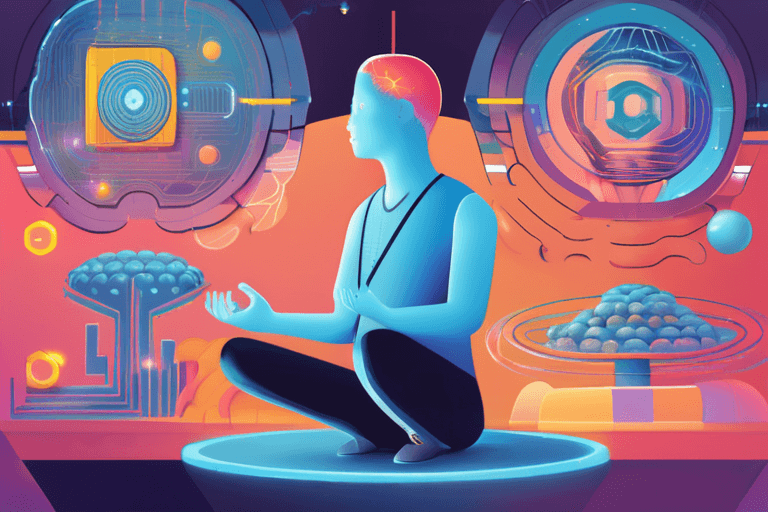
Meditation, once viewed as a state of mental rest, has been revealed as a period of heightened brain activity, according to a recent study. Simultaneously, advancements in artificial intelligence continue to emerge, with new language models achieving record-low hallucination rates and innovative techniques enabling models to learn new skills without losing existing knowledge. These developments highlight the evolving landscape of both human consciousness and technological innovation.
Researchers from the University of Montreal and Italy's National Research Council analyzed the brain activity of 12 monks from the Thai Forest Tradition at a Buddhist monastery outside Rome. Using magnetoencephalography (MEG), they found that meditation significantly alters brain dynamics, challenging the traditional view of meditation as a state of mental quiescence (Source 1).
In the realm of AI, Chinese AI startup z.ai unveiled its latest large language model, GLM-5. This open-source model, released under an MIT License, achieved a record-low hallucination rate on the independent Artificial Analysis Intelligence Index v4.0. With a score of -1 on the AA-Omniscience Index, GLM-5 demonstrated a 35-point improvement over its predecessor, leading the industry in knowledge reliability (Source 2). "GLM-5 now leads the entire AI industry, including U.S. competitors like Google, OpenAI and Anthropic, in knowledge reliability by knowing when to abstain rather than fabricate information," according to VentureBeat (Source 2).
Meanwhile, researchers at MIT, the Improbable AI Lab, and ETH Zurich developed a new technique called self-distillation fine-tuning (SDFT). This method allows large language models to acquire new skills and knowledge without compromising their existing capabilities. SDFT leverages the in-context learning abilities of modern LLMs, consistently outperforming traditional supervised fine-tuning (SFT) (Source 3).
The rapid advancements in AI also bring forth concerns. As noted by MIT Technology Review, AI agents can be risky, especially when equipped with tools that interact with the outside world. This has led to the emergence of independent developers like Peter Steinberger, whose tool OpenClaw allows users to create their own bespoke AI assistants (Source 4).
The use of LLMs in various applications, including app development, is also gaining traction. As highlighted in a Hacker News post, LLMs can accelerate the implementation of new features. However, ethical considerations must be addressed before fully embracing these technologies (Source 5).



















Discussion
AI Experts & Community
Be the first to comment