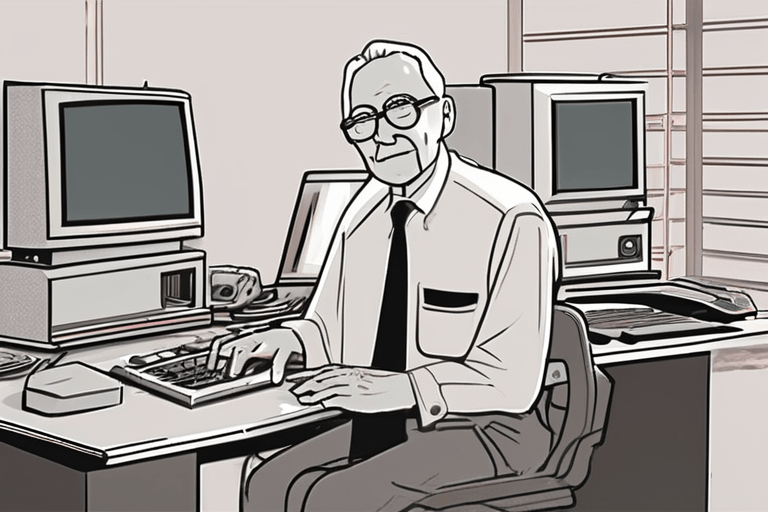
Robert Tinney, the artist whose airbrushed cover paintings defined the look of Byte magazine, died at the age of 78 on February 1, according to a memorial posted on his official website. Tinney's work, which spanned over a decade starting in 1975, gave a visual language to the abstract world of personal computing, translating concepts like artificial intelligence and networking into vivid, surrealist-influenced paintings.
Tinney was the primary cover artist for Byte from 1975 to the late 1980s, and he painted more than 80 covers during his career, according to Ars Technica. His illustrations were instrumental in shaping the public's perception of early personal computers.
In other news, a campaign called "QuitGPT" is urging people to cancel their ChatGPT subscriptions. The campaign, which was highlighted on MIT Technology Review, is critical of OpenAI's president Greg Brockman's contributions to a political super PAC and the use of a ChatGPT-4 powered résumé screening tool by U.S. Immigration and Customs Enforcement (ICE).
Meanwhile, a software developer in Singapore, Alfred Stephen, shared his frustrations with ChatGPT's coding abilities and meandering replies, which led him to discover the QuitGPT campaign. He had purchased a ChatGPT Plus subscription for $20 a month to speed up his work.
In the realm of software development, a project called "peon-ping" was introduced on Hacker News. This project provides Warcraft III Peon voice notifications for Claude Code, designed to alert users when the code needs attention. The tool uses voice lines from the game to notify users, ensuring they don't miss important updates.
Also discussed on Hacker News was the topic of making a living as an artist. One author shared their experience of earning a living as an artist, documenting their theories on how to earn enough money to buy the remainder of their time so they could create more art. The author had sales of $54,000 in one year and was about to have a year with $150,000 in sales.
Finally, a post on Hacker News discussed the status of Heroku. The author, who had worked at Salesforce Heroku, stated that Heroku is not dead, despite initial impressions. The author, who was the tech lead of the production engineering operations experiences team, clarified that Heroku is still operational.



















Discussion
AI Experts & Community
Be the first to comment