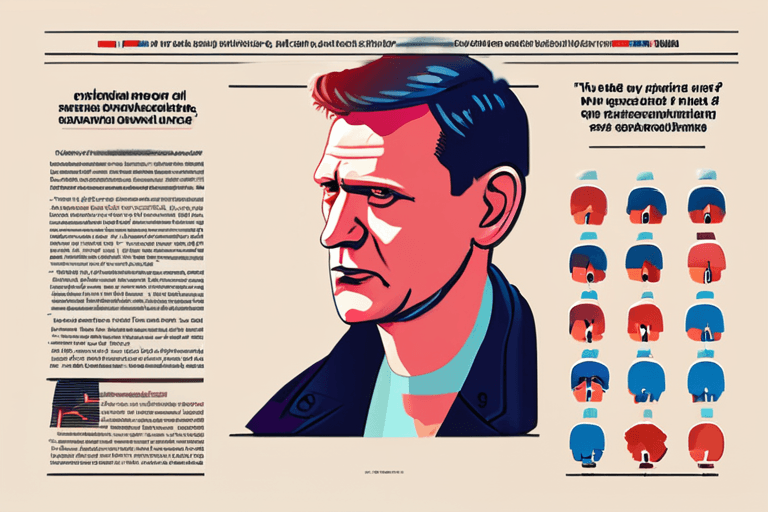
Five European countries have accused the Russian government of murdering Alexei Navalny, the country's leading opposition figure, by poisoning him with a toxin found in a South American frog, according to a statement released on Saturday. The accusation, made by the foreign ministries of Britain, France, Germany, Sweden, and the Netherlands, represents the most concrete Western claim to date that Navalny was murdered in an Arctic prison two years ago.
Samples taken from Navalny's body showed the presence of epibatidine, a toxin found in poison dart frogs native to South America, the statement detailed. The statement added that the toxin is not found naturally in Russia. The European governments asserted that only the Russian government had the means, motive, and opportunity to deploy the lethal toxin against Navalny during his imprisonment.
In other news, the head of global ports operator DP World, Sultan Ahmed bin Sulayem, resigned from his position after mounting pressure over his links to convicted sex offender Jeffrey Epstein. Newly-released files revealed that Sulayem exchanged hundreds of emails with Epstein over a decade, according to Reuters. DP World announced his resignation, effective immediately, on Friday, naming Essa Kazim as chairman and Yuvraj Narayan as chief executive.
Meanwhile, in the realm of technology, an AI safety researcher at US firm Anthropic resigned with a warning that the "world is in peril." Mrinank Sharma, in his resignation letter shared on X, cited concerns about AI, bioweapons, and the state of the wider world as his reasons for leaving. He stated he would pursue writing and studying poetry and move back to the UK to "become invisible." This news comes in the same week that an OpenAI researcher resigned, expressing concerns about the company's decision to deploy adverts in its chatbot.
Also, a new "at home" technology is being trialed to help stroke survivors regain movement. Amanda James-Hammett, who had a stroke six years ago, is participating in a nationwide NHS trial testing the device. "It's about freedom," she said. "It's given me my freedom back." The technology is being tested at 19 NHS sites.
Finally, Gisèle Pelicot, the woman at the center of France's largest rape trial, shared her experience with BBC Newsnight. She described the moment she realized the scale of her husband's crimes as "like a tsunami." She is preparing to release her memoir, "A Hymn To Life."




















Discussion
AI Experts & Community
Be the first to comment