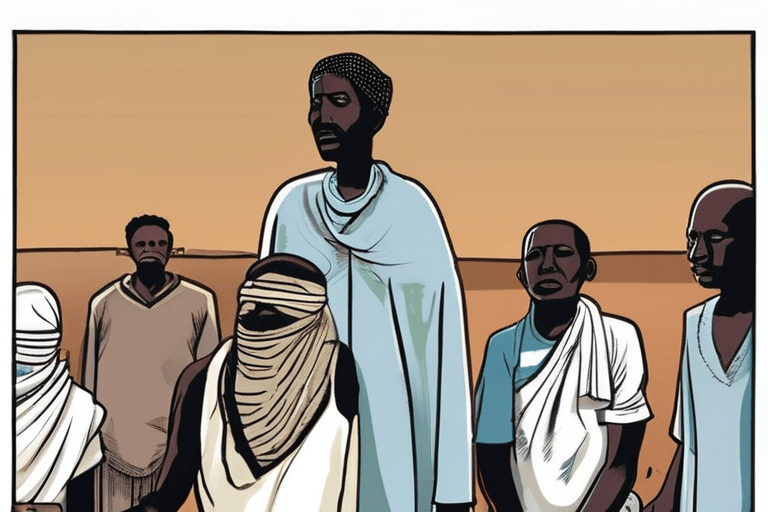
More than 6,000 people were killed in a three-day offensive by the Rapid Support Forces (RSF) in Sudan's el-Fasher in late October, according to the United Nations. The UN Human Rights Office reported that the RSF's attack included widespread atrocities that may constitute war crimes and crimes against humanity.
The RSF's assault on el-Fasher, located in the Darfur region, was described as a wave of intense violence "shocking in its scale and brutality," according to the UN. The offensive aimed to capture the city. This information was reported by NPR News.
The news summary from NPR News also covered other significant events, including the government funding impasse over immigration, the fallout from the Epstein files release, and the ongoing search for Savannah Guthrie's missing mother. Additionally, the summary highlighted major protests in Munich demanding regime change in Iran, along with scientific confirmation of Navalny's poisoning. Political developments such as discussions on European mutual defense and US Secretary of State Rubio's tour of Central Europe were also included.
In other news, former President Donald Trump held a campaign-style rally at Fort Bragg, an active Army base in North Carolina, on Friday. He urged troops to vote for Republicans and criticized Democrats. Trump shared the stage with Michael Whatley, a former Republican National Committee chairman and Senate candidate, while touting his military spending plans and celebrating his restoration of the Fort Bragg name, according to Time. "You have to vote for us," Trump told the troops.
A Sky News report, drawing from multiple sources, detailed the account of Juliette Bryant, a survivor of Jeffrey Epstein's trafficking ring. Bryant recounted being recruited from Cape Town at age 20 and subsequently sexually assaulted on a private jet. She described the psychological manipulation and "invisible chains" that kept her ensnared for years, highlighting the trauma and the role of her recruiters, who allegedly laughed during the assaults.
Ars Technica published an article with fabricated quotes generated by an AI tool, violating its standards and policies against using AI-generated material without clear labeling. The publication has since apologized, stating it was an isolated incident, and has reviewed recent work to ensure no further issues. This incident highlights the risks of over-reliance on AI tools and the importance of adhering to journalistic integrity.
















Discussion
AI Experts & Community
Be the first to comment