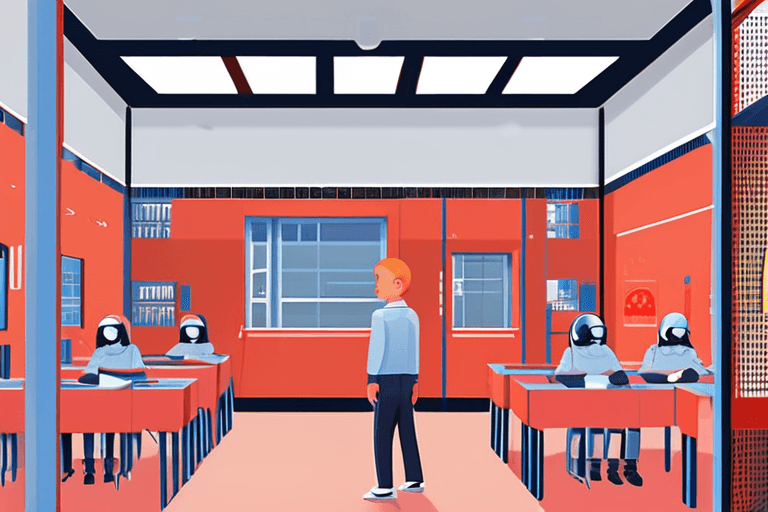
In the shadow of the Ural Mountains, in the industrial town of Karabash, School No. 1 was once a haven. For Pavel Talankin, a videographer and events coordinator, it was a place of laughter, music, and youthful exuberance. He meticulously documented school life, capturing holiday parties, graduation ceremonies, and the spontaneous creativity of his students. "I loved this place," Talankin, 34, said, his voice tinged with nostalgia. "I loved what we were doing before the war." His office, a refuge for students seeking respite, became a hub for guitar sessions, card games, and amateur music video production. But beyond the surface of everyday school life, Talankin was unknowingly capturing something far more profound: the subtle yet pervasive influence of the state on Russia's next generation.
Talankin's story offers a glimpse into a complex and evolving landscape where technology, ideology, and education intersect. In today's Russia, the shaping of young minds is no longer confined to traditional classrooms. Artificial intelligence (AI) is increasingly being used to personalize learning, monitor student behavior, and even curate the information they consume. This raises critical questions about autonomy, bias, and the potential for manipulation.
The use of AI in education is not unique to Russia. Globally, AI-powered tools are being implemented to automate administrative tasks, provide personalized tutoring, and assess student performance. However, in countries with authoritarian tendencies, these technologies can be repurposed to promote specific narratives and suppress dissenting voices. Imagine an AI-powered learning platform that subtly emphasizes nationalistic values while downplaying critical perspectives on historical events. Or a facial recognition system that flags students who express opinions deemed unfavorable by the government. These scenarios, while seemingly dystopian, are becoming increasingly plausible.
Talankin's role as a videographer inadvertently placed him on the front lines of this ideological battleground. "I'm just standing there filming, and I understand that what's getting into the camera isn't just a lesson, but history," he reflected. He was capturing not only the curriculum but also the subtle cues and messages that reinforce a particular worldview. The carefully chosen historical narratives, the patriotic songs sung during school events, the emphasis on national unity – all contribute to shaping a generation's understanding of their country and its place in the world.
The implications of this trend are far-reaching. As AI becomes more sophisticated, its ability to influence young minds will only increase. Algorithms can be designed to target specific demographics with tailored messages, reinforcing existing biases and creating echo chambers of information. This can lead to a society where critical thinking is stifled, and independent thought is discouraged.
The latest developments in AI, particularly in the field of natural language processing (NLP), are particularly concerning. NLP allows AI systems to understand and generate human language, making them capable of creating highly persuasive and personalized content. Imagine an AI-powered chatbot that engages students in conversations, subtly steering them towards certain viewpoints. Or an AI-generated news article that presents a biased account of current events. These technologies have the potential to manipulate public opinion on a massive scale.
"Usually, everyone, it seems to me, was waiting for break when we could crash into Pavel Ilyich's office and discuss everything," a former student recalled, highlighting the importance of spaces where young people can freely express their thoughts and challenge prevailing narratives. As AI becomes more pervasive in education, it is crucial to protect these spaces and ensure that students have access to diverse perspectives and critical thinking skills.
The story of Pavel Talankin serves as a cautionary tale. It reminds us that technology is not neutral. It can be used to empower and educate, but it can also be used to control and manipulate. As we move towards an increasingly AI-driven future, it is essential to be vigilant and to safeguard the values of freedom, autonomy, and critical thinking. The future of Russia's next generation, and indeed the future of societies around the world, depends on it.
















Discussion
Join the conversation
Be the first to comment