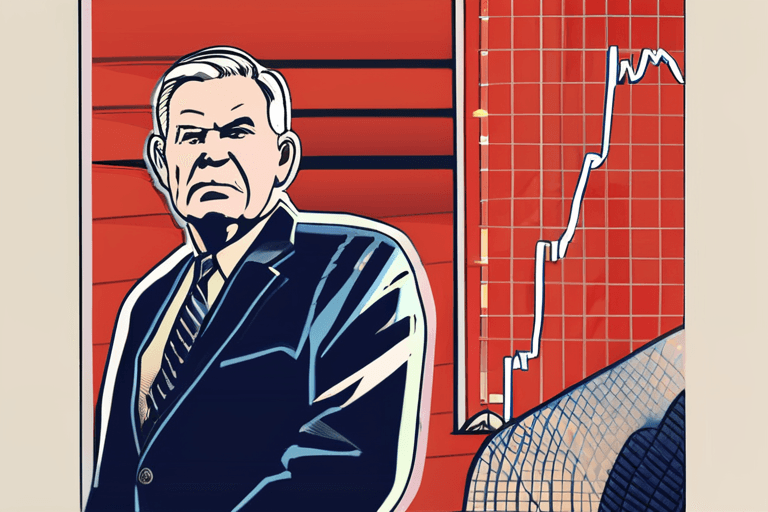
A tremor ran through Wall Street on Monday. Not the kind caused by algorithms gone haywire, but one rooted in the very human drama of power, politics, and the perceived independence of the Federal Reserve. Stocks dipped, the dollar weakened, and even the bedrock of U.S. government bonds wobbled as news broke of a criminal investigation into Fed Chair Jerome Powell. The markets, those complex, interconnected webs of code and human sentiment, reacted with a collective intake of breath.
The investigation, details of which remain closely guarded, arrives at a particularly sensitive time. Powell's term as Fed chair concludes in May, adding another layer of uncertainty to an already volatile economic landscape. This situation echoes last year's "sell America trade," a period marked by President Trump's vocal criticism of Powell and challenges to the Fed's autonomy. The central bank has faced relentless pressure to lower interest rates, a move the administration believes will boost affordability, especially in the housing market.
The Fed's independence is a cornerstone of modern monetary policy. It's the firewall that theoretically separates economic decisions from political whims. But what happens when that firewall is perceived to be under attack? The market's reaction – the dip in stocks, the dollar's slide – suggests a loss of confidence, a fear that decisions might be swayed by political considerations rather than purely economic data. Gold, often seen as a safe haven in times of uncertainty, surged to a record high, a clear signal of investor anxiety.
"The market is essentially pricing in a risk premium," explains Dr. Anya Sharma, a professor of financial economics at Stanford University. "When the perceived independence of the central bank is threatened, investors become wary. They demand a higher return to compensate for the increased uncertainty." This "risk premium" translates into higher bond yields, making it more expensive for the government to borrow money.
Powell, in a rare video statement released on Sunday, acknowledged the Justice Department's grand jury subpoenas and vowed to perform his duties without political influence. "I will carry out my duties without political fear or favor," he stated, a sentiment intended to reassure the markets. However, the market's reaction suggests that words alone may not be enough to quell the unease.
The situation highlights the delicate balance between human oversight and algorithmic trading in today's financial markets. While AI algorithms can process vast amounts of data and react to market changes with lightning speed, they are ultimately driven by the data they are fed and the parameters set by human programmers. A sudden shock, like the news of the Powell investigation, can trigger a cascade of automated sell orders, exacerbating the initial market reaction. This is where human judgment and experience become crucial, to assess the underlying causes of the market movement and prevent a potential panic.
Looking ahead, the market's reaction to the Powell investigation serves as a stark reminder of the importance of central bank independence and the potential consequences of political interference in monetary policy. The coming months will be critical in determining whether the Fed can maintain its credibility and navigate the turbulent waters of political pressure and economic uncertainty. The stability of the U.S. financial system, and indeed the global economy, may well depend on it.















Discussion
Join the conversation
Be the first to comment