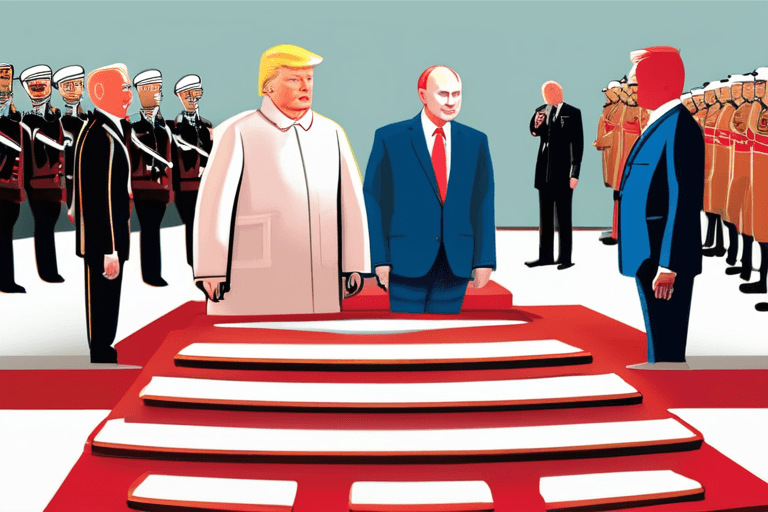
Amidst escalating tensions in Eastern Europe, a stark assessment has emerged from Poland’s President Karol Nawrocki: only Donald Trump possesses the leverage to deter Vladimir Putin's aggression. In an exclusive interview with the BBC, President Nawrocki voiced his conviction that the former US president holds the key to de-escalating the conflict in Ukraine and safeguarding the region.
President Nawrocki's pronouncements arrive at a critical juncture. The war in Ukraine continues to rage, and anxieties are mounting in neighboring countries, including Poland, which shares a border with both Ukraine and Belarus, a close ally of Russia. The Polish leader's endorsement of Trump, a figure known for his unconventional diplomatic approach, underscores the depth of concern within the Polish government regarding Russia's assertive foreign policy.
Nawrocki's support for Trump predates his recent visit to Britain, where he engaged in discussions with Prime Minister Sir Keir Starmer and other prominent figures. He believes Trump is uniquely positioned to resolve the ongoing crisis. "He can solve this problem," Nawrocki stated, referring to the broader threat posed by Russia and the specific conflict in Ukraine.
The context of Nawrocki's remarks is crucial. Last September, Poland experienced a significant incursion when over 20 Russian drones breached its airspace from Belarus and Ukraine. "Until that time, no NATO member state had experienced a drone attack on that scale," Nawrocki emphasized, characterizing it as "an extraordinary situation." He interpreted the incident as a deliberate test of Poland's defensive capabilities by Russia.
While Nawrocki's perspective highlights a sense of urgency and a belief in Trump's potential influence, it is not without its counterpoints. Critics argue that relying solely on one individual, particularly one with a history of unpredictable foreign policy decisions, is a risky strategy. Some analysts suggest that a more unified and multilateral approach, involving strong alliances and consistent diplomatic pressure, would be more effective in containing Russia's ambitions.
The BBC sought comment from several foreign policy experts. Dr. Anya Schmidt, a specialist in transatlantic relations, noted, "While Trump's 'America First' approach may resonate with some who feel traditional alliances have been ineffective, it also risks alienating key partners and undermining the collective security framework that has been in place for decades."
Furthermore, the policy details of how Trump might achieve a breakthrough remain unclear. During his presidency, Trump pursued a complex relationship with Putin, marked by both periods of apparent cordiality and instances of confrontation. Whether he would adopt a more conciliatory or assertive stance in a potential future engagement is a matter of speculation.
As the war in Ukraine continues and geopolitical tensions simmer, President Nawrocki's endorsement of Donald Trump as a potential peacemaker adds a new layer of complexity to the ongoing debate about how best to address the challenges posed by Vladimir Putin's Russia. The coming months will reveal whether this perspective gains traction and whether Trump himself will play a role in shaping the future of European security.
















Discussion
Join the conversation
Be the first to comment